Unearthed, will be shown for the first time in the UK in Alchemy, a group show a collaboration between Thrown Contemporary and Omved Gardens in Highgate11-26th May. This body of work is a campaigning combination of clay stop-frame animation and ceramics that magically creates an illusion of life celebrating healthy soil teeming with amazing biodiversity. There is an aptness to using clay to investigate the hidden world of soil. Playing with scale, Jo Pearl makes the invisible visible as we zoom downwards, discovering ever smaller beings. Balletic characters – inspired by worms, bugs, fungal mycelium and bacteria – dance out of her imagination. This magnified biome beneath our feet, beguiles and whispers a plea for us to ‘Save Our Soil’.
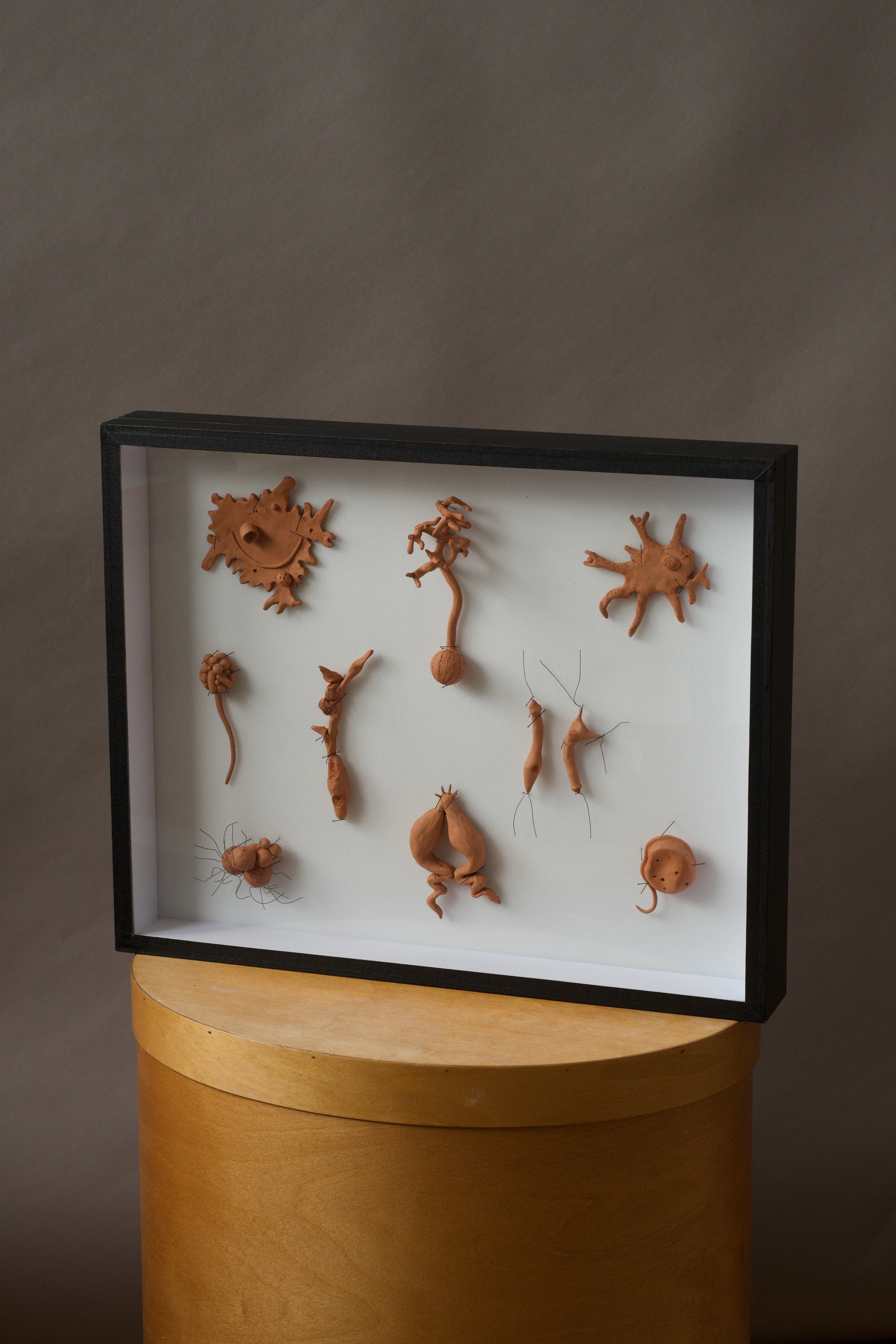
Alongside the short film, ‘microscopic’ ceramic characters, some of which were created during the animation process, are shown as zoological specimens. Drawing on an historical tradition of explorers’ specimen collections pinned into entomology cases, the fauna displayed is strange. As though in suspended animation, we have time to examine and wonder at unexpected shapes and textures.
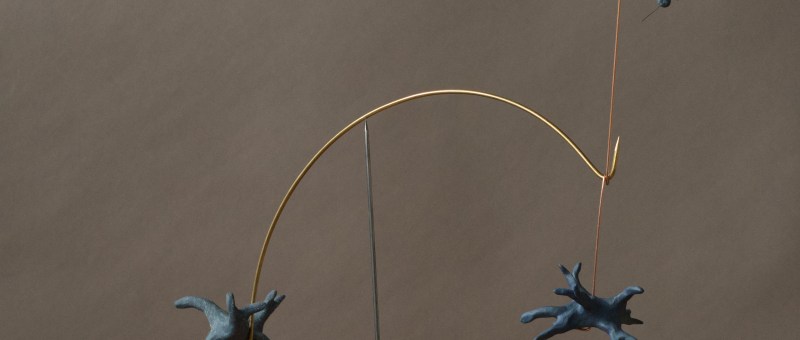
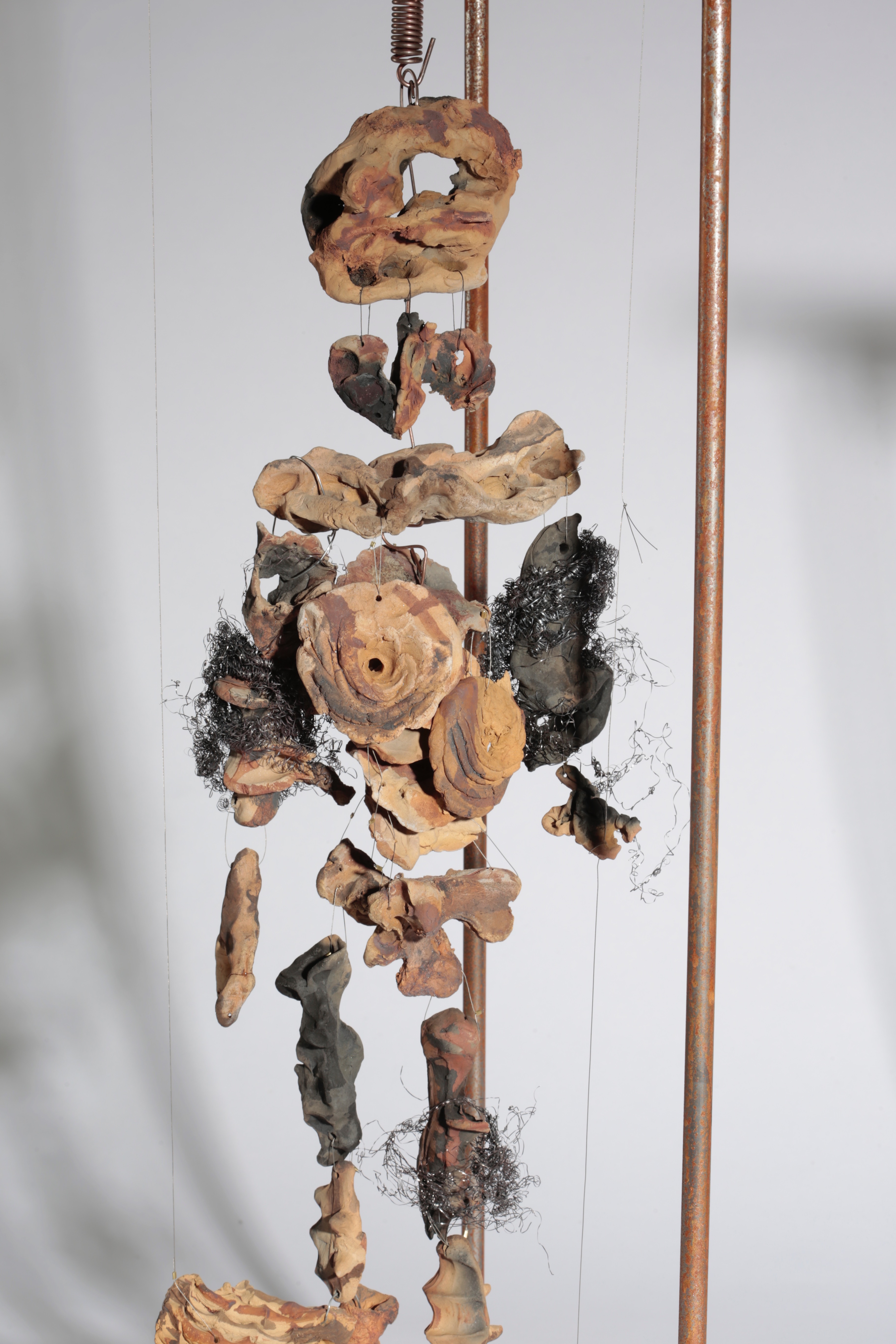
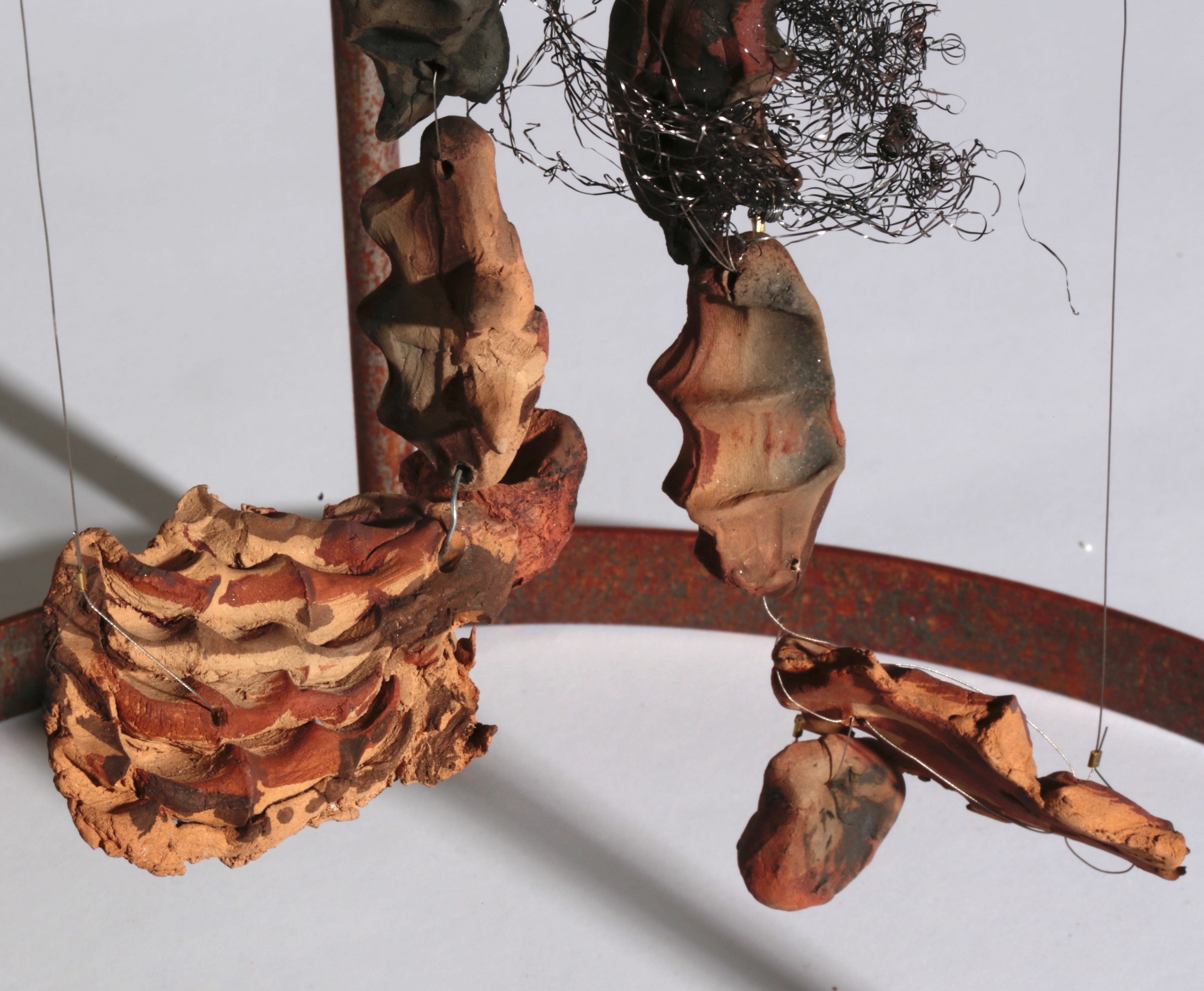
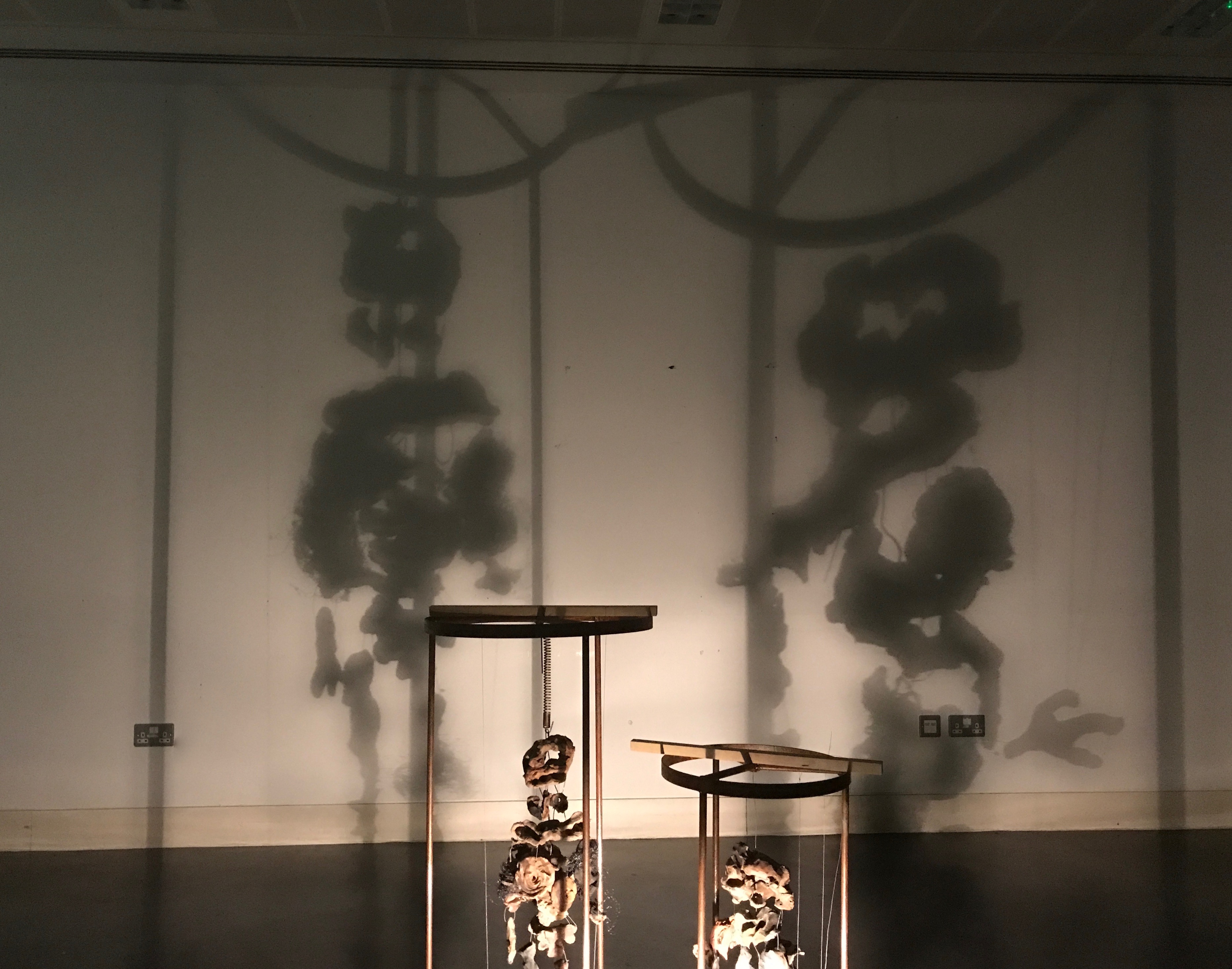
Brand new work – kinetic ‘stabiles’ also breathe life into these ceramic beings with microbes, worms and mycelium spinning and swinging in space. Each teeters on delicately balanced brass and mild steel rods, expressing the precariousness of the fragile equilibrium in our soil’s biome.
Over the last 6 months I have been working away on a commission for Undisclosed, a group show curated by Nicola Hockley and Caroline Evans, seeking to expose Modern Slavery as a 21st Century crime. The show runs from 2 March – 18th April at The Hostry exhibition space in Norwich Cathedral, with the Private View on 10th March 6-8pm. Everyone is invited! The plinths are being made, the catalogue is being printed – but before I share photos of the completed work, I thought I would post about the research and making process I have been through.
The Problem of Modern Slavery
I confess I did not know much about the subject before being invited to exhibit. It turns out despite slavery having been abolished in 1833 – it is still alive and kicking here in the UK, and frighteningly prevalent in the production of cheap food and agricultural products. Although it takes many forms from children in county lines drug running, to trafficked sex workers, to valet car washes, the bit that most shocked me was the prevalence of debt bondage in the supply chain of the food we buy weekly from our favourite supermarkets. The pressure to supply cheap cheap goods, means companies look the other way when agencies send them inexpensive and submissive workers, often non-english speaking, who turn up corralled into vans, often down at heal. These are some of the tell tell signs that employers need to look out for if they don’t want their products tainted by the scourge of slave labour. Victims of modern slavery are invariably in fear of their lives from those who lured them to this country with the promise of good work, and then demand that they pay back the cost of flights, accommodation, use of tools – with vastly inflated rates, and despicably low rates of pay. Victims of debt bondage slip ever deeper into debt, while attempts to flee or argue back are met with violence – or threats of violence to family back home. It is a sorry tale. And a blight on the way we consume. But once you know you can’t un-know.
Making Every Little Helps
Slavery blooming in UK agriculture
We have been conned by consumerism and seduced by the lured of the bargain. Indeed being a bargain hunter is pretty much considered a virtue. I fell for it. For more than 10 years I have been buying a couple of bunches of cheap daffodils in my weekly Sainsbury’s shop each spring. A two quid treat for me and my family to brighten the kitchen table. Where’s the harm in that? Well it turns out Cornish Daffs are/have been produced with slave labour. It’s no wonder when you consider they are picked by hand, and yet 10 blooms cost just £1. That one pound has to cover the bulbs, planting, tending, hand picking, processing, packaging, delivery to the distribution centre and then on to the supermarkets AND making a profit for shareholders. For me it became clear – if the goods are seductively cheap, and it involves manual labour, someone is getting screwed over.
Every Little Helps
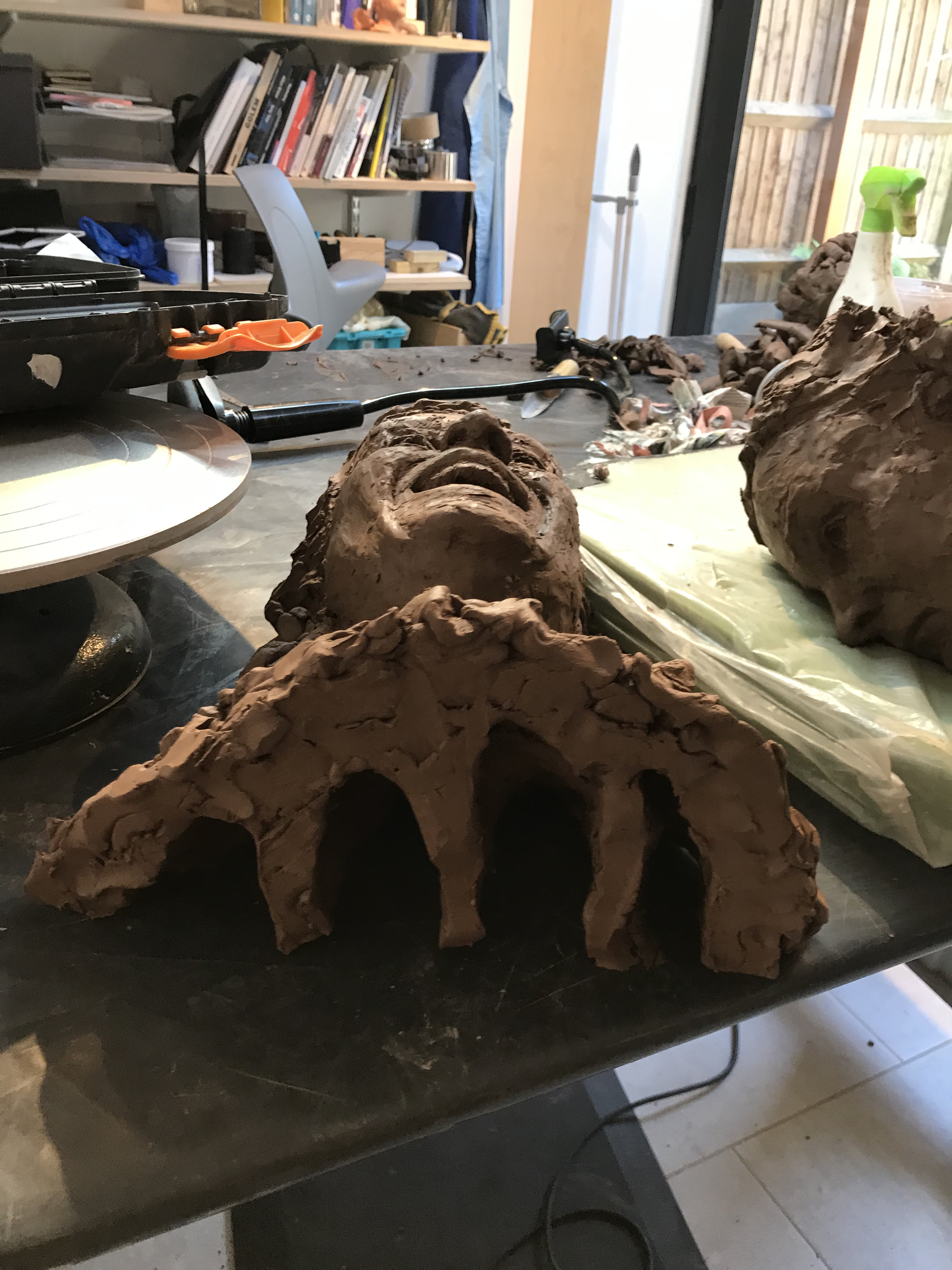
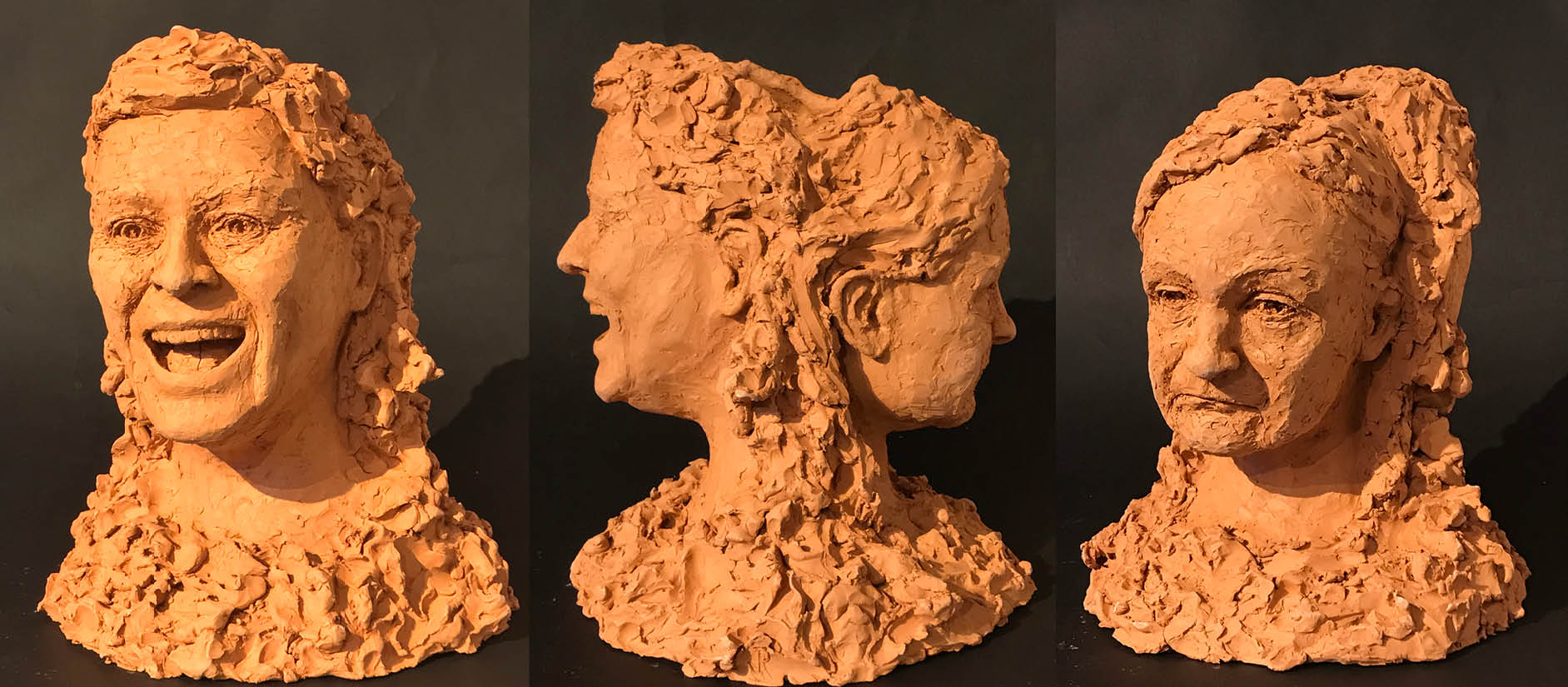
This terracotta Janus Head, ‘Every Little Helps‘ references Tesco’s strap line. Every little bit of exploitation and cutting of corners, as well as mechanisation helps to keep the price down – but at what cost? This piece is my attempt to take responsibility for my role in the cheap daffodil trade. On one side I have sculpted a self portrait of me as the Bargain Hunter – with a crazed expression of someone who has just spotted an irresistible deal. On the other, is a portrait of an actual survivor of Modern Slavery who kindly agreed to sit for me. I travelled to the Welsh borders to meet up with her, hear about her experiences and take photographic visual references to be able to sculpt the portrait. I wanted to capture a sense of the desolation and dehumanising numbness that she described to me when she was trapped in forced labour. Although my muse was not herself involved in the daffodil production, it was confirming to hear she was glad I was wanting to highlight this story. The contrast between the charm and beauty of daffodils, and the processes at play to get them to market will hopefully shock viewers. The piece will be displayed in Norwich with fresh daffodils coming out of the aperture in the top of the head.
A Feast of Modern Slavery – it is everywhere
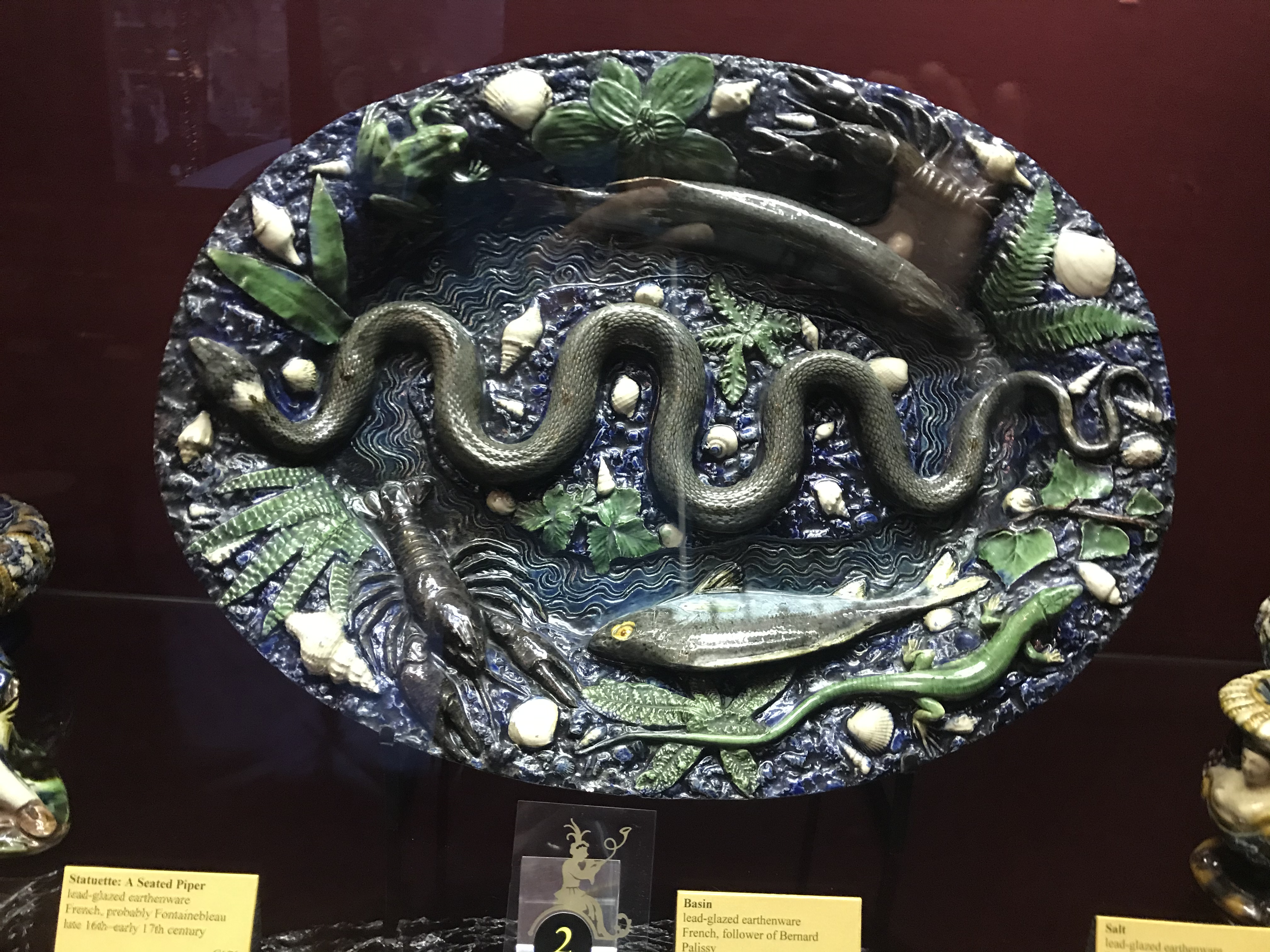
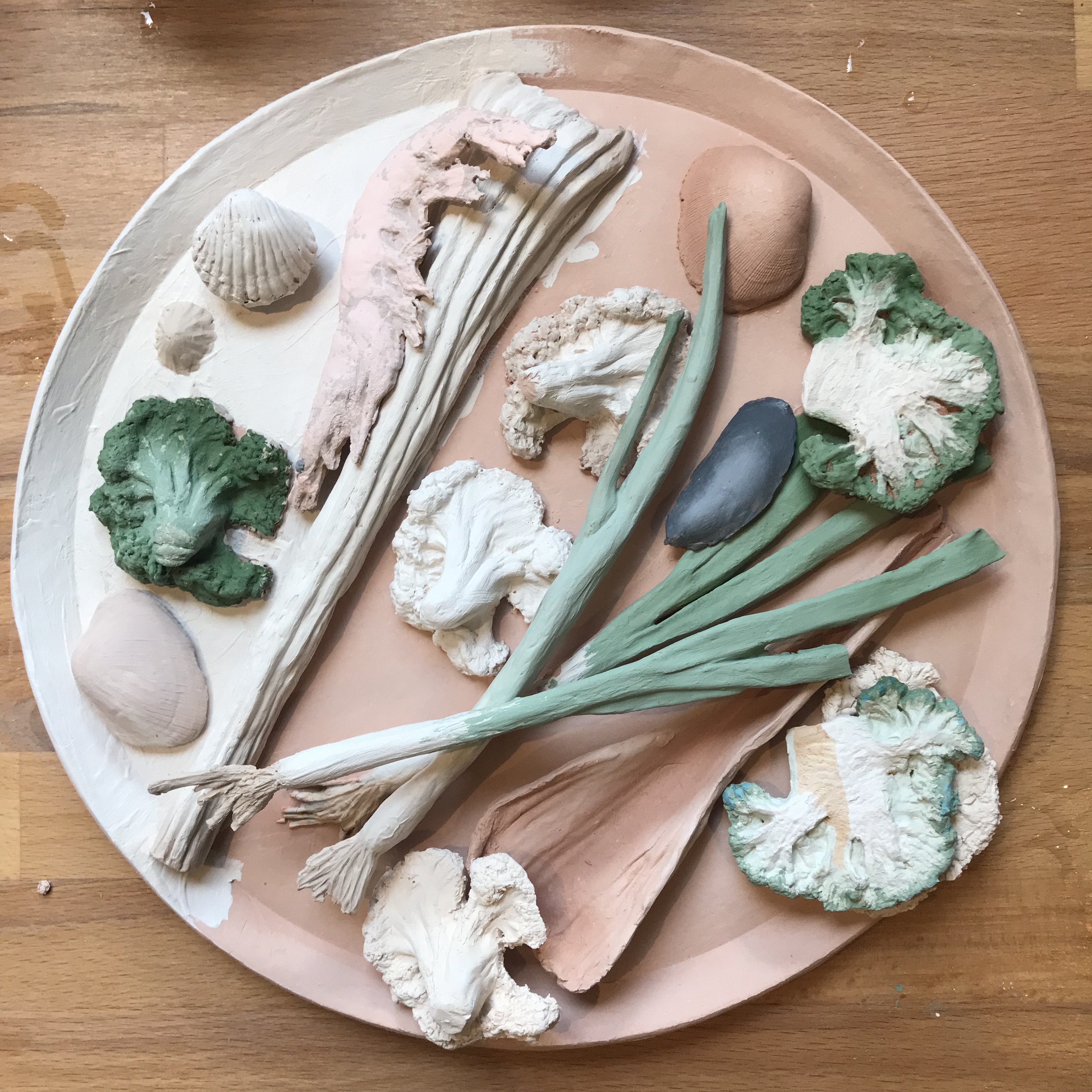
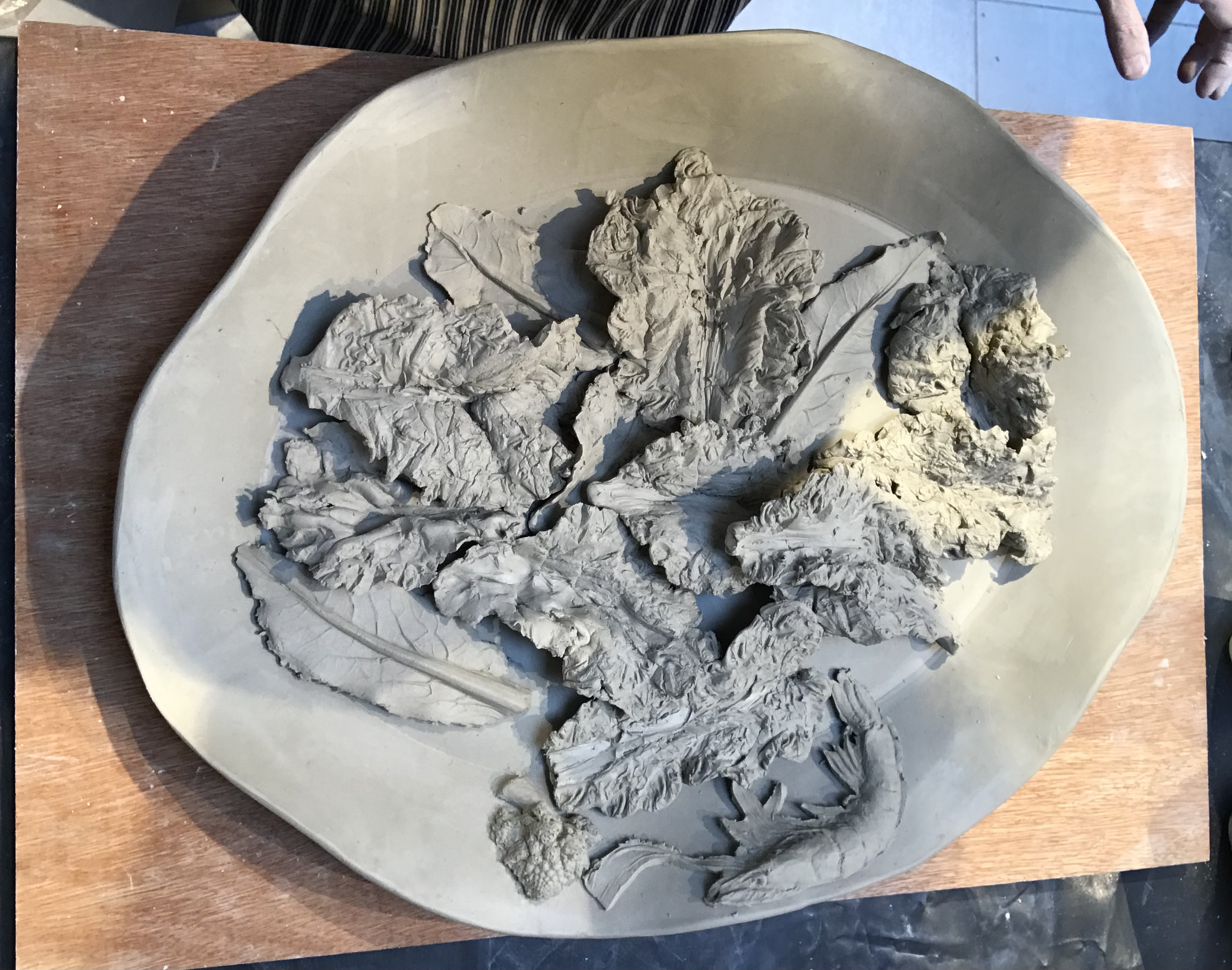
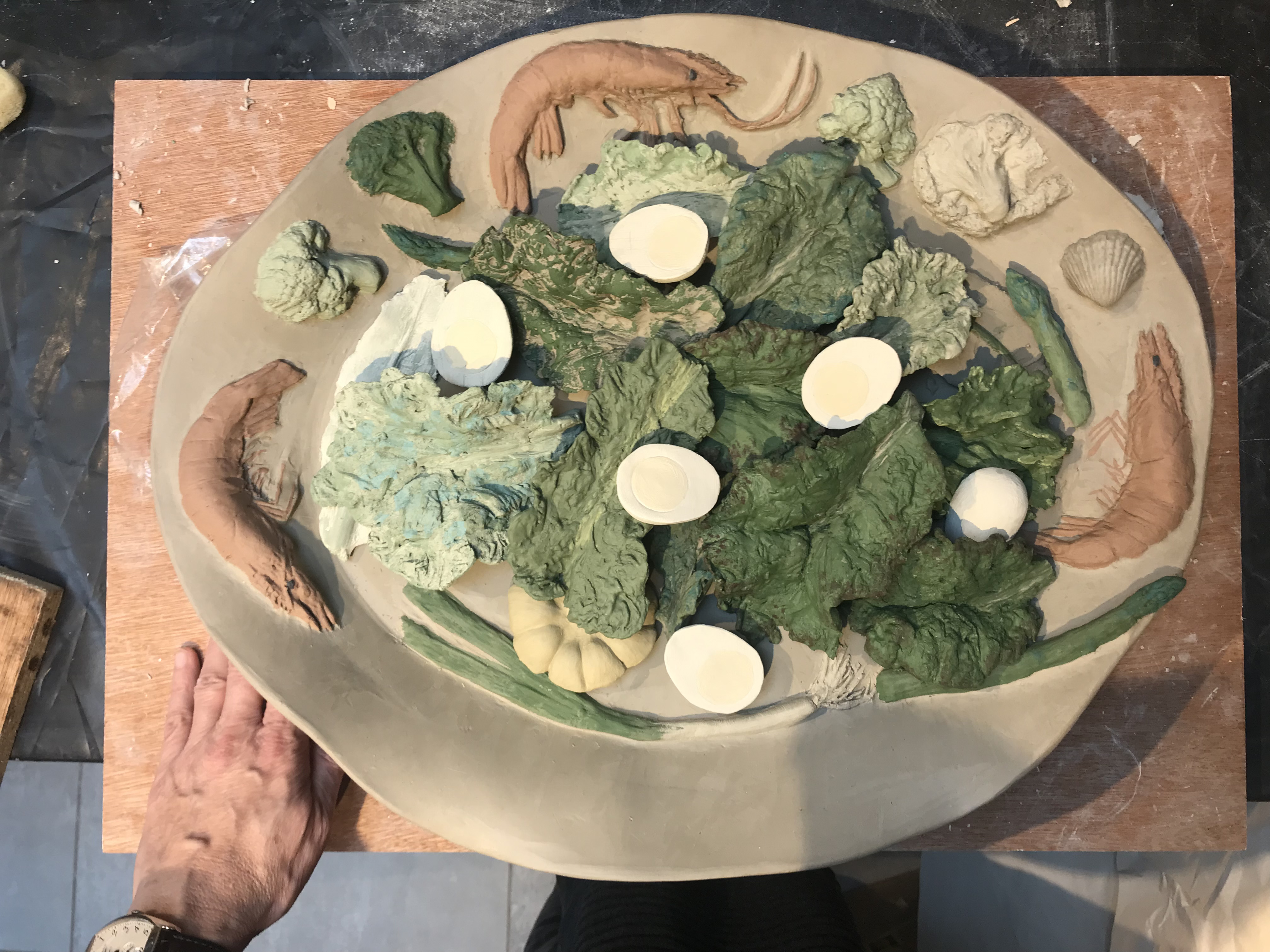
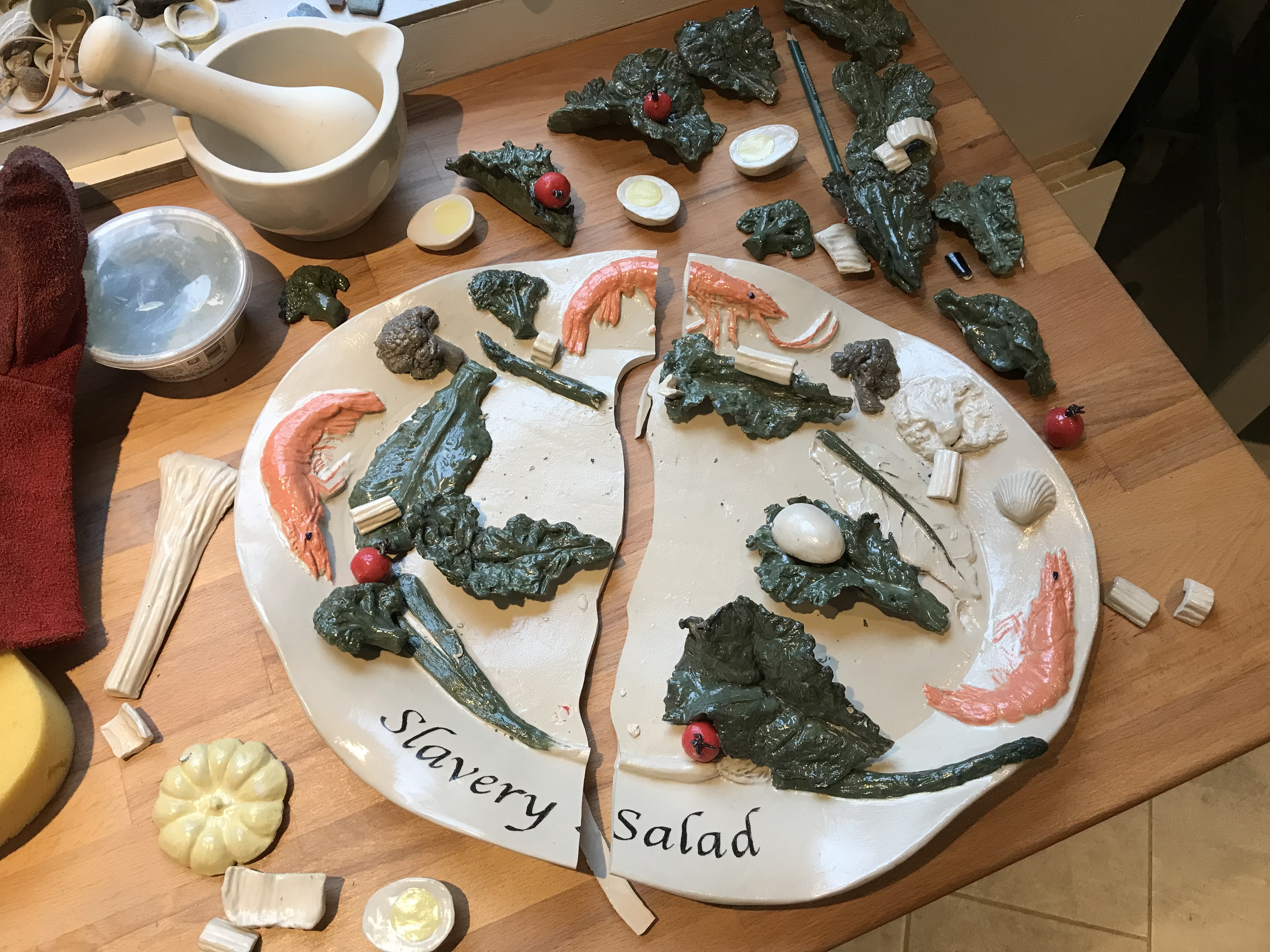
My research also revealed that that modern slavery is now so endemic in UK food production, from planting and harvesting, to packing and processing, that an expert who works in the industry told me if I wanted to sculpt the food that is produced using modern slavery, I could choose anything I liked to represent – it is everywhere! So I made a slavery salad – an homage to 16th Century master-ceramicist Bernard Palissy, press moulding shrimp and cockle shells (remember the trafficked Morecambe Bay Cockle pickers who drowned), shrimp, lettuce, asparagus, and eggs to create an abundant platter of glossy but tainted food.
Bernard Palissy Platter I saw at the Wallace Collection in 2020Making this work took weeks of clay and glaze testing, rediscovering mould making, and a few kiln disasters
You Can’t Walk Away
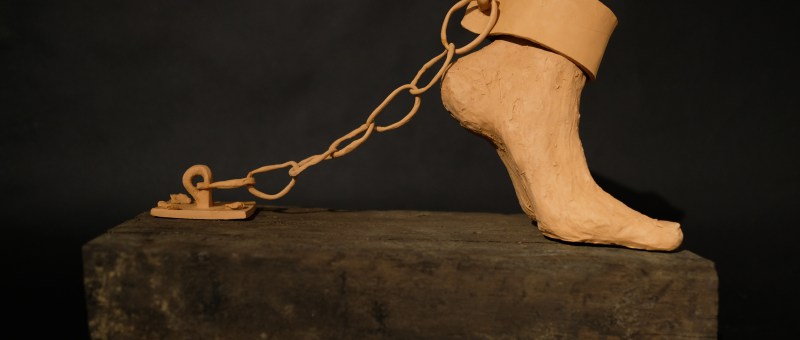
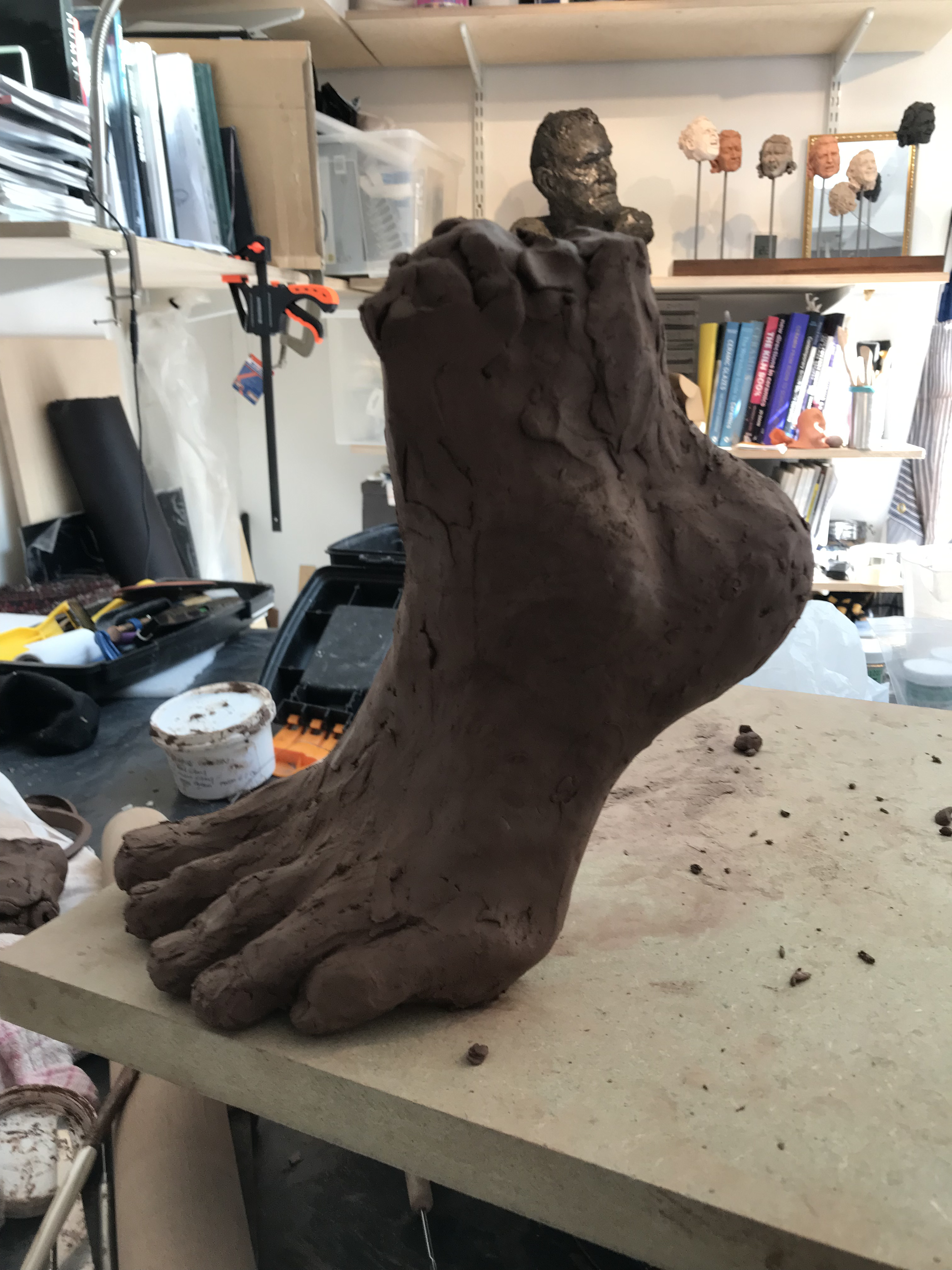
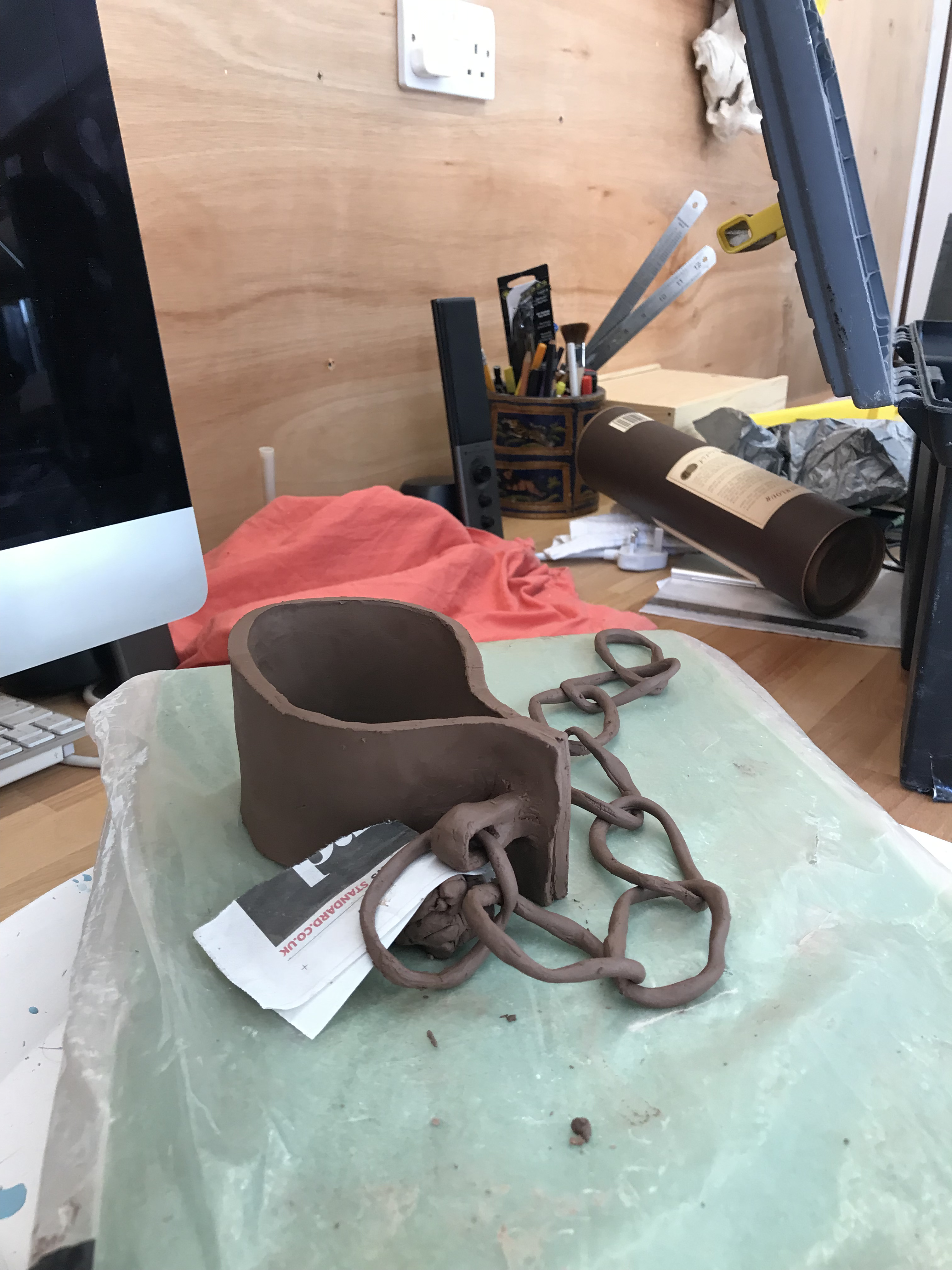
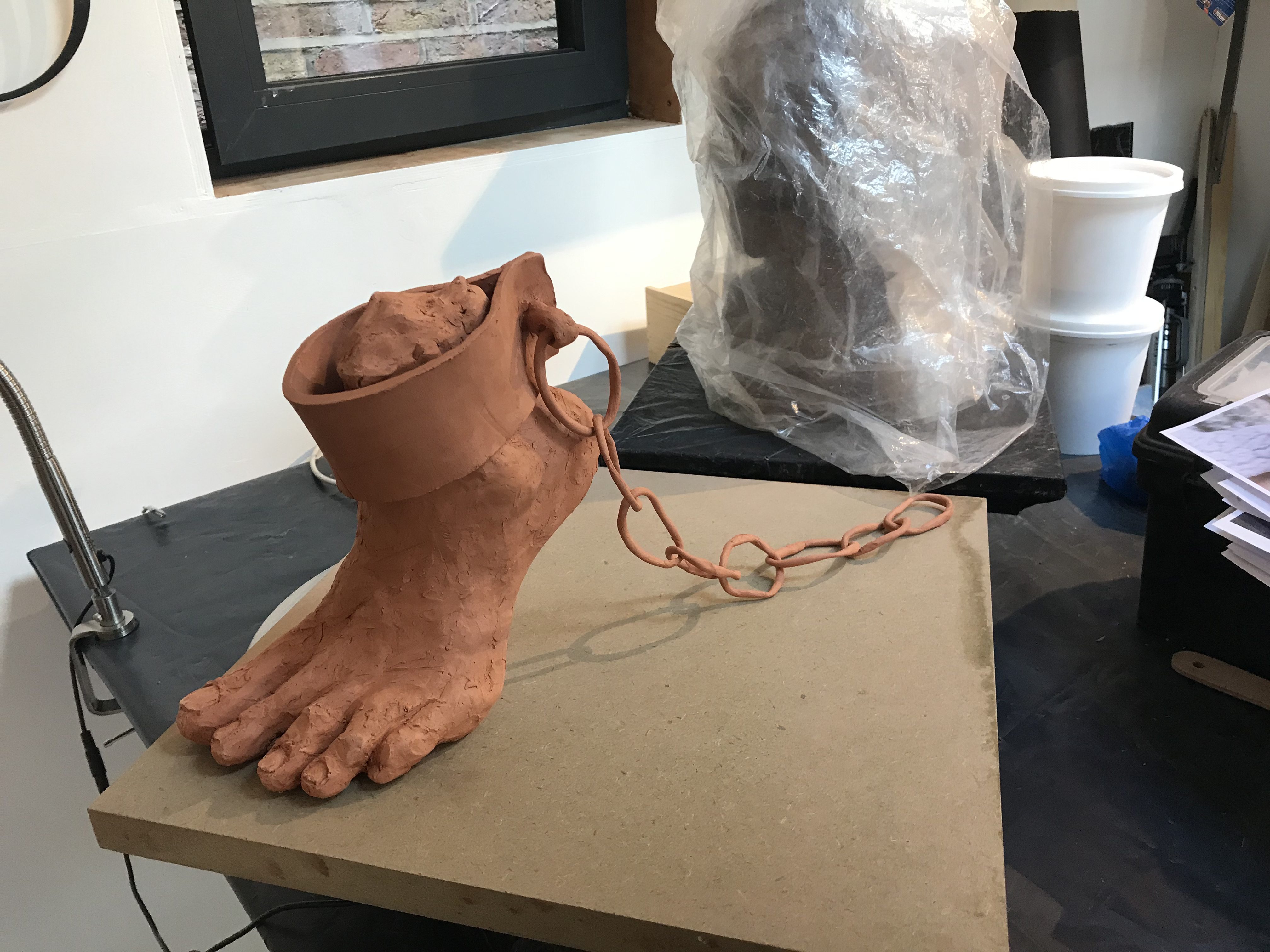
The third sculpture that I have made for the Undisclosed is called – ‘You Can’t Walk Away‘ – a quote from Blood and Earth by Kevin Bales. This statement is the simplest definition of modern slavery. If you can’t walk away from your job for fear of violence, arrest, and crippling debt then you are experiencing slave labour. This terracotta shackled foot, that is straining to get away and yet fixed in place also references the terrible shackles of the transatlantic slave trade. I chose to sculpt in terracotta clay as its high iron content – just like blood, gives the clay its distinctive red colour.
Ancient Clay Infographics
Finally, I made a fourth piece called 77 Percent that responds to a 2020 survey by The Ethical Trading Initiative with the Hult Business schoolwhich revealed that 77% of UK corporations believe that they have modern slavery somewhere in their supply chains. I was shocked – that’s over three quarters of everything we buy has been produced using unacceptable labour practices at some point in their supply chain. It takes the shine off consumerism no?
Maquette
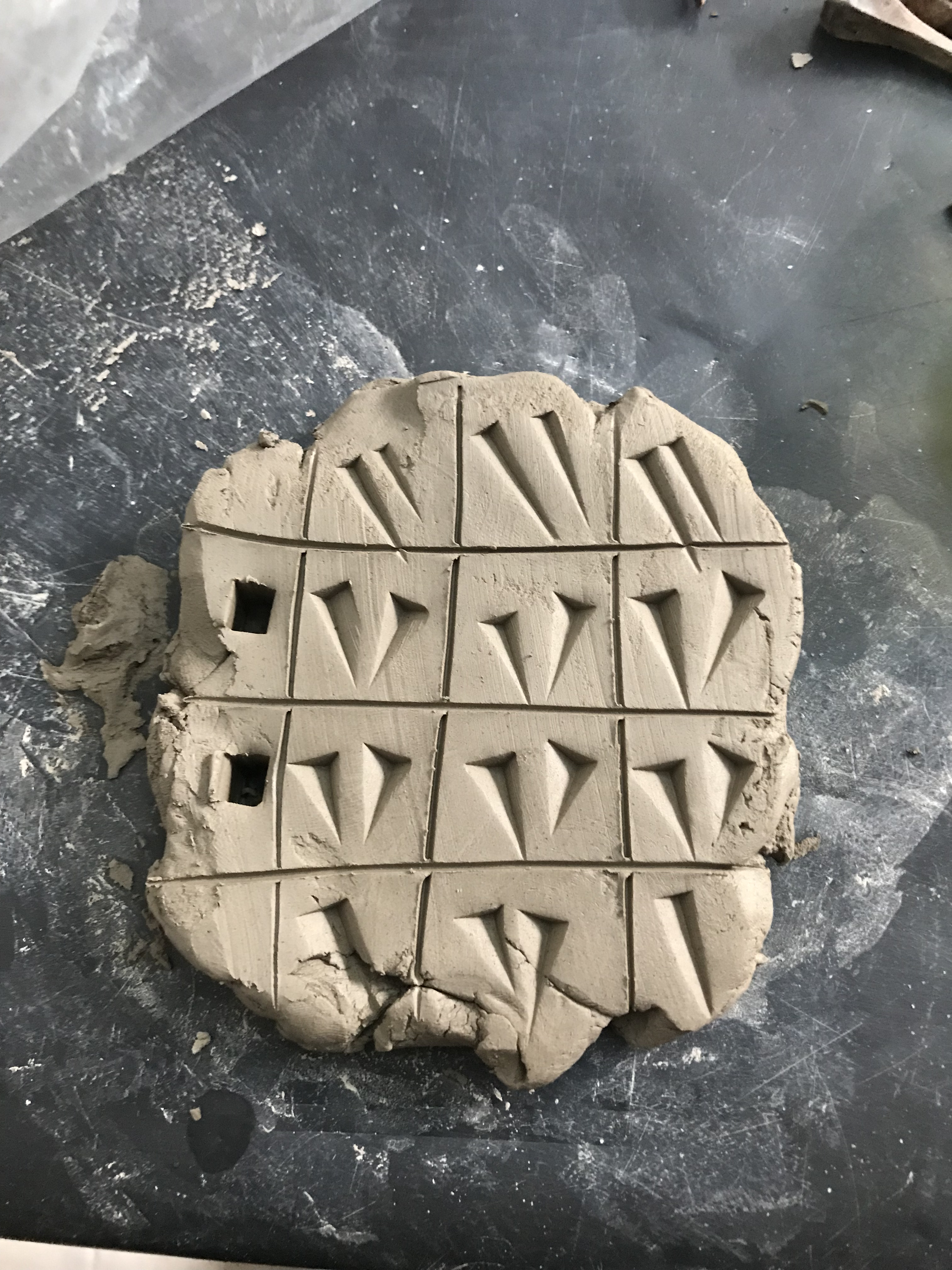
77 Percent is inspired by cuneiform clay tablets, humanity’s oldest known form of writing. Babylonian and Sumerians often used clay tablets for accounting purposes – to record bushels of wheat harvested, or numbers of slaves owned. It felt appropriate that this story of slavery – sadly a tale as old as time – should be told using a clay tablet.
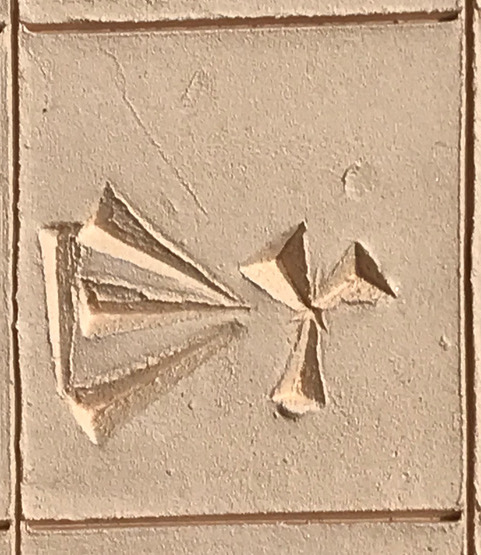
To communicate the statistic I divided a leather hard clay slab into a 10×10 grid, and then inscribed the cuneiform word for female slave into 77 of the 100 squares.
Why female slave? I was fascinated to learn that cuneiform means wedge script – due to the wedge shaped stylus used to score the clay. But this wedge shape also shares an etymological root with the Latin Cuneus – for triangular wedge and the arguably vulva – that is the root for the modern words: c*nt and c*nilingus
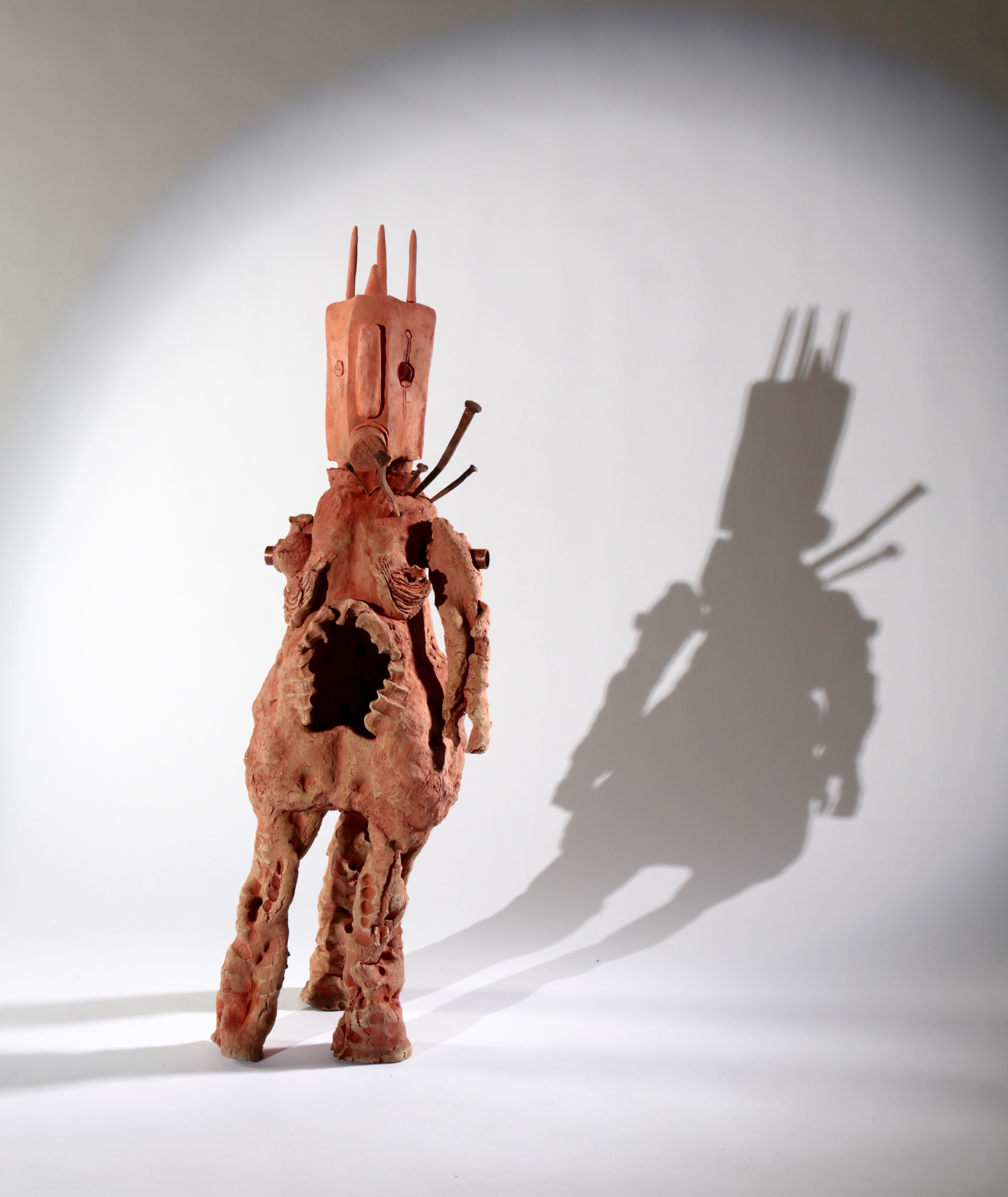
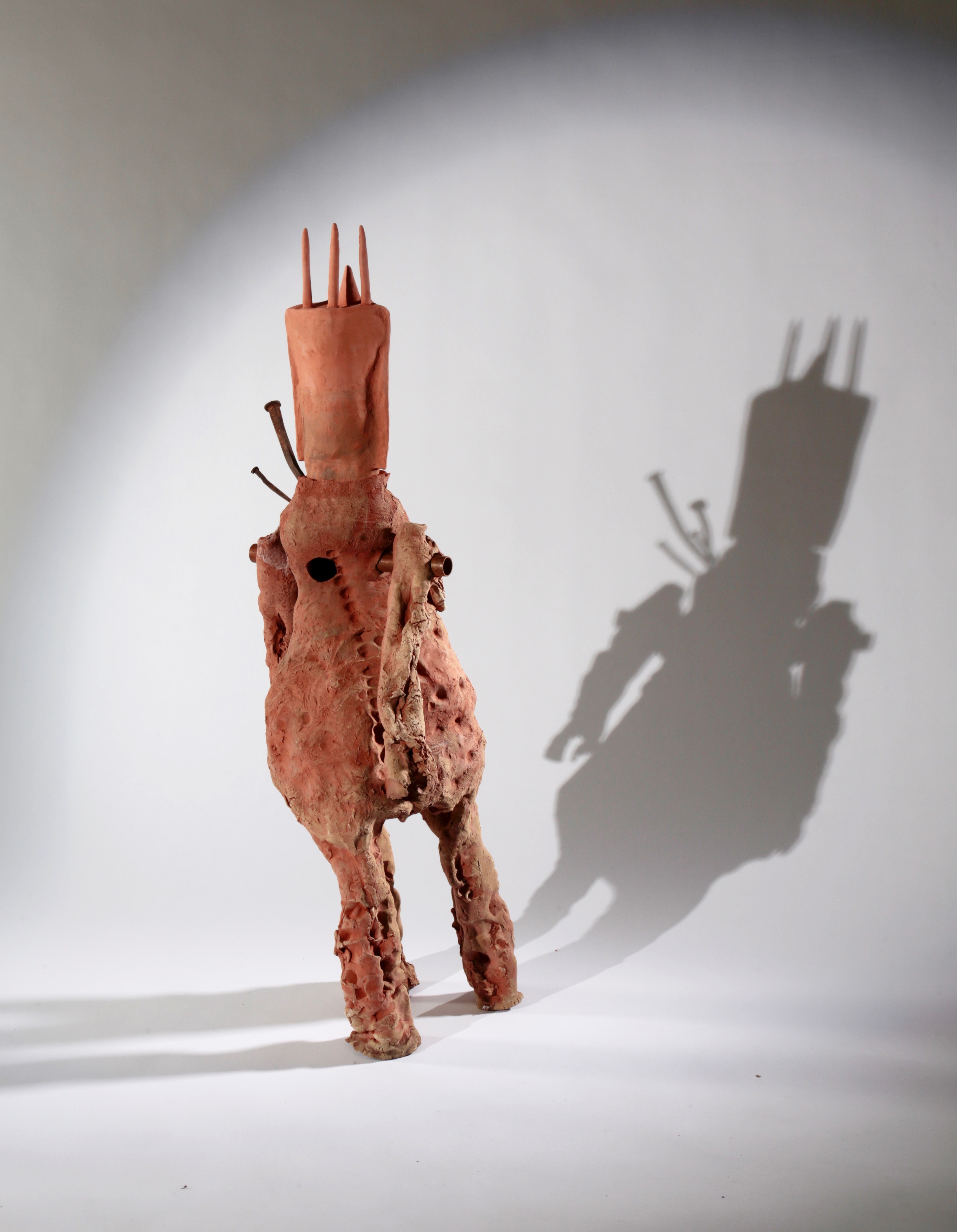
Primordial figure with belly of despair where viewers can whisper a magic incantation to wake the golem. Sculpture evokes marionettes that can be breathed into life, like a voodoo cult figure.
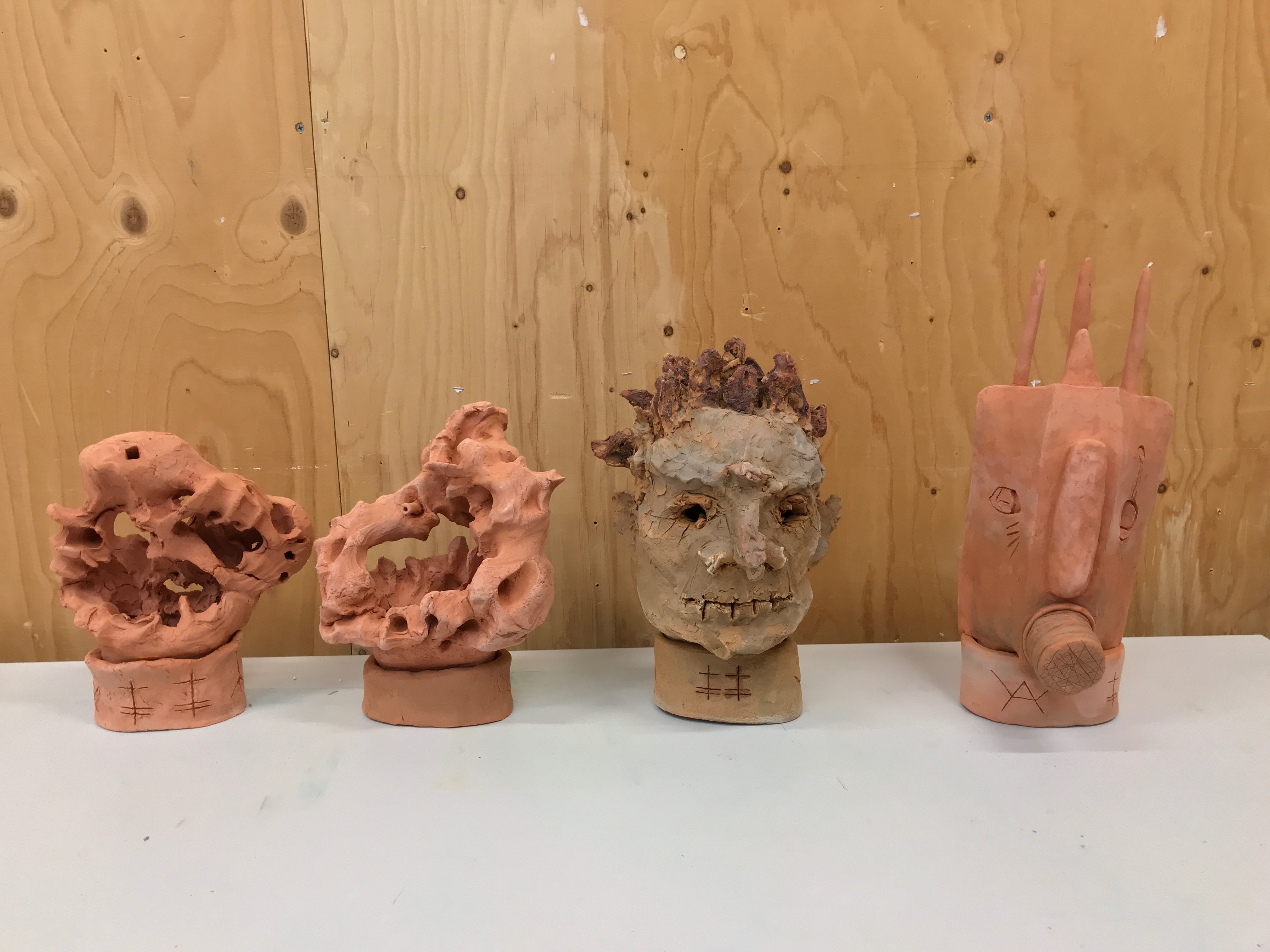
Faced with the startling rise of political extremism around the world I have become particularly inspired by the myth of the Golem: a powerful mythical being, made by man out of the earth, and breathed into life by magic, usually to protect a community from attack.
Over the last year, this archetypal character has resonated perfectly with my feelings of disorientation as I no longer recognise our political landscape. It has felt as though only a superhuman force will be able to sort this mess out for me. Reaching for the clay I have been experimenting with how I could make a golem, and what that would feel like.
As an archetype, the Golem represents Man’s enduring desire to ‘play god’: to create powerful beings or entities out of inanimate objects in order to protect us or fix an intractable problem. But while the myth is intrinsically hopeful in outlook it is also deeply troubling as it highlights humankind’s propensity towards ‘hubris’, an arrogant miscalculation of the unintended consequences of our creations. A warning looms: Be careful what you wish for.
I have been relishing the fact that the golem archetype is intrinsically linked to my chosen discipline of sculpting figuratively in clay, and plays to my propensity towards political activism. Having generated the work featured in this post earlier this year, I am currently returning to the shadow puppet as the focus of my month-long residency in Bermondsey with Collective Matter – the wonderful ceramic studio led by Katie Spragg and Eva Masterman. Seizing the opportunity of dedicated studio space and large kiln, I am producing a human scale golem marionette that will hopefully be exhibited in the Potting Shed gallery space curated by Collective Matter at Contemporary Sculpture Fulmer, in the coming months. Watch this space.
The last two years have been difficult. I have been hard hit by the result of the Brexit Referendum and Trump’s election to the White House. Trying to find ways to channel my political frustrations and concerns into the clay.
This week I am again taking part in an Associated Clay Workers Union (ACWU) group exhibition at Southwark Cathedral in the Lancelot Link, this time on the theme of Votive. The act of offering votives into water is used in many cultures and throughout history from early Neolithic times. Hopeful ritual acts to engender change in the future, votives are often given in dedication or as a consequence of a vow. They are a ritual performance undertaken in uncertain times and in thanks for subsequent relief.
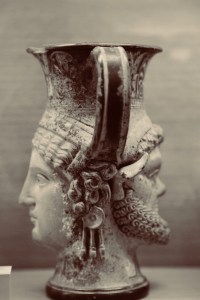
Responding to this theme, it seemed like an ideal opportunity create a piece to express my prayers for a People’s Vote on the final Brexit Deal, including an option to stay within the EU. Inspired by a Roman chalice I saw a few years ago in the Louvre, and thinking about Janus, the Roman god of transitions who is represented on the gates of Rome with two heads facing in opposite directions, I chose to make a double portrait of Theresa May and Jeremy Corbyn. On one level two sides of the same Brexit coin.
Roman Janus Chalice
I reworked the chalice archetype by creating a ballot box out of their heads rather than a sacrificial vessel. Both Corbyn and May appear to me to be inextricably linked in the current political trajectory towards what appears will be a No Deal Brexit. From my perspective both politicians have been two-faced Remainers. Both campaigned for Remain, but have been been responsible for a shocking shift towards a hard Brexit. Corbyn’s lack of leadership and opposition on Brexit has been deafening. To me he appears to be aiding and abetting the UK’s exit from the EU, a betrayal to his Islington Constituents, of which I am one, and Londoners who voted over-welmingly for Remain and to young people, stalwart Remainers who he proports to represent.
Visual Reference for the Portraits
Visual Reference for the Portraits
Visual Reference for the Portraits
Visual Reference for the Portraits
Reference Images for the Portraits
Visual Reference for the Portraits
I have deliberately chosen to not fire Votive for a Vote on the Final Brexit Deal. The intension is to take the work to its natural conclusion and ‘gift’ it to the Thames at the end of the show, as a ritual offering, in the hope that my prayers come true.
The exhibition is being staged within the annual Totally Thames Festival programme, and after the show has come down on Sunday 30th September, at Midday – which is low tide, my fellow ACWU makers and I will be offering the unfired work to the Thames. It will take place on the Thames foreshore, Queen’s Walk, Bankside, in front of The Globe Theatre. The unfired clay sculptures will be placed on the shingles, and allowed to be sacrificially washed away and returned to mud by the capital’s tidal waters.
Come down if you can, to both the exhibition and the Gifting, and spread the word about the #Peoplesvote. It’s not a done deal. We demand the right to a vote on the final Brexit Deal, including an option to remain in the EU if we do not like the terms of the deal, or no deal. If you want to take action now, click here to sign the People’s Vote petition.
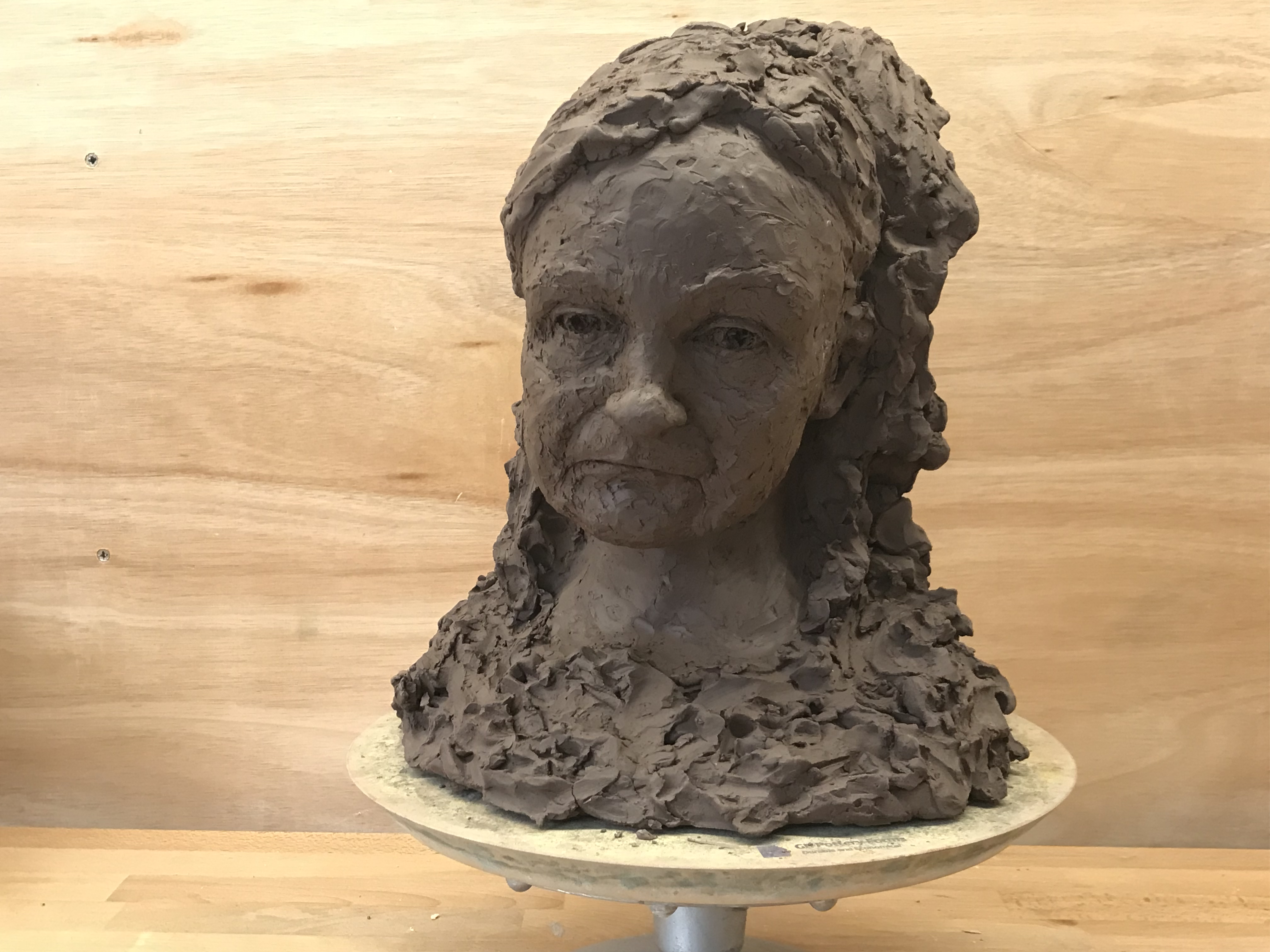
Over the last 6 months, I have been grappling with the challenging question of what is the point of attempting to sculpt portraits in an era of 3D scanners and printers. After all, these amazing machines can make exact facsimiles of complex shapes including humans, showing all the tiny details, like eyelashes and wrinkles. How can I or any practicing portrait artist possibly compete? This summer, I had a go, taking part in a 3 day workshop with Portrait Artist Hazel Reeves at Morely College. She was full of top techniques of how to capture a likeness. See my rendition of Anne below.
But it seems that the Royal Academy is thinking about this challenge too. A few weeks ago I noticed an article about the public being invited to be 3D Scanned by The Veronica Scanner, the high tech brainchild of Madrid-based Factum Arte, located this week at the Royal Academy. All the time slots was all sold out when I tried to book but was so excited yesterday when I received an email saying I had won a competition to be included in the cohort of people being recorded.
The scan took all of 4 seconds, and despite my best efforts to think about how I would like to compose my face, when put in the scanning pod, my face went into a rictus stare. Reminiscent of the stress of being in a passport photo-booth, only this time 8 cameras on a mechanical arm whizzed round the pod taking 96 photographs of me from all angles. Factum Arte will email the digital file of me in the coming days. I am now mulling over how I can explore the boundaries between exact printed portraits and hand modelling. There is a ceramic printer at college so the first step when terms starts will be to print and fire the Mini-Me.
Watch this space!
The Scream
Extreme expression
Me & Veronica Scanner
Head milled in wood
Printed in chocolate!
Padre Justo Gallego printed at various different scales
Early stages of modelling Roman style votive foot for the ACWU London Bridge project
Roman inspired feet, for the ACWU London Bridge Project
So I am associate member of of ACWU – the Associated Clay Workers Union. A wonderful collective of non-functional ceramic artists who are come together to make joint site specific projects in unusual settings. As a Ceramic student I am still on the fringe of this budding organisation, but I was delighted that they have included me in a project they are organising with Transport for London at London Bridge. The wonderful Alison Cooke and Diane Eagles approached the contractors responsible for the renovations of London Bridge Station and asked if we might have some clay dug from under the station, to use to make site specific work, based on the history of this area of London. They agreed and screwed down 30m into the earth below the station, with one of those enormous pilling drivers and brought us up some virgin clay that is 50 million years old! A successful grant application to London Potters Association brought ACWU £500 with which to hire a van to collect the clay, and buy a box and sieve for all the ACWU artists to enable them to transport and process the clay. Even after seiving and drying on a bat in the spring sunshine, the clay is very sticky, and quite tricky to work with.
Soaking the rock hard clay in water for a few weeks made it maliable enough to sieve and make ready for modelling.
The archaeological dig that took place before building work at London Bridge began, revealed a rich history dating back to Roman Times. In fact an oil lamp in the shape of a foot was found under the construction site. Which is my starting point. I am thinking of giving my foot nail polish, with a nod to gender issues we face today. I will keep you posted as to how the project progresses.
Roman oil lamp in the shape of a foot found under London Bridge station
Greek foot from the Elgin Marbles
ACWU is working to exhibit the work in London Bridge Sation at some point late summer or early autumn. I will keep you updated as to when this will take place!
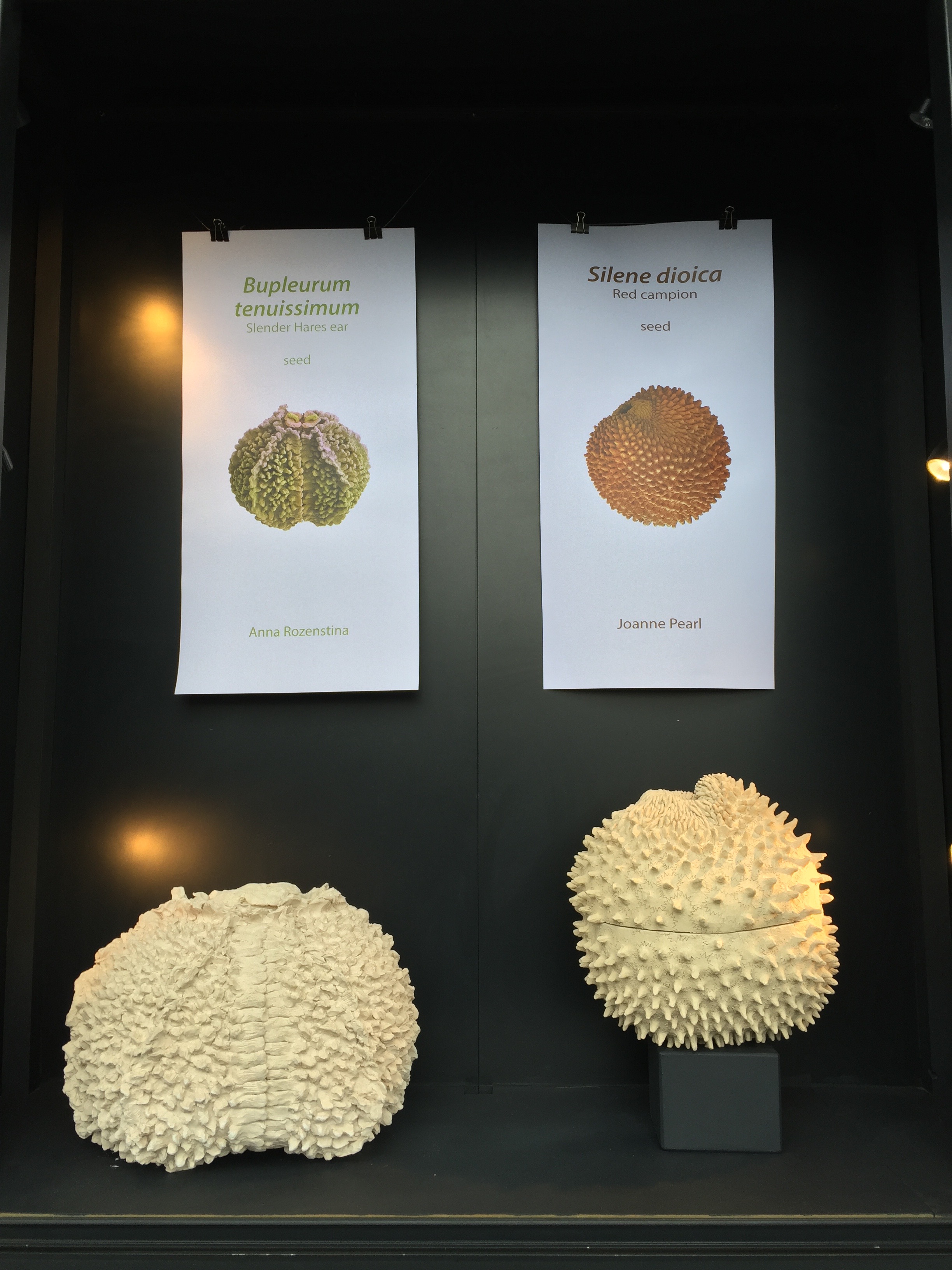
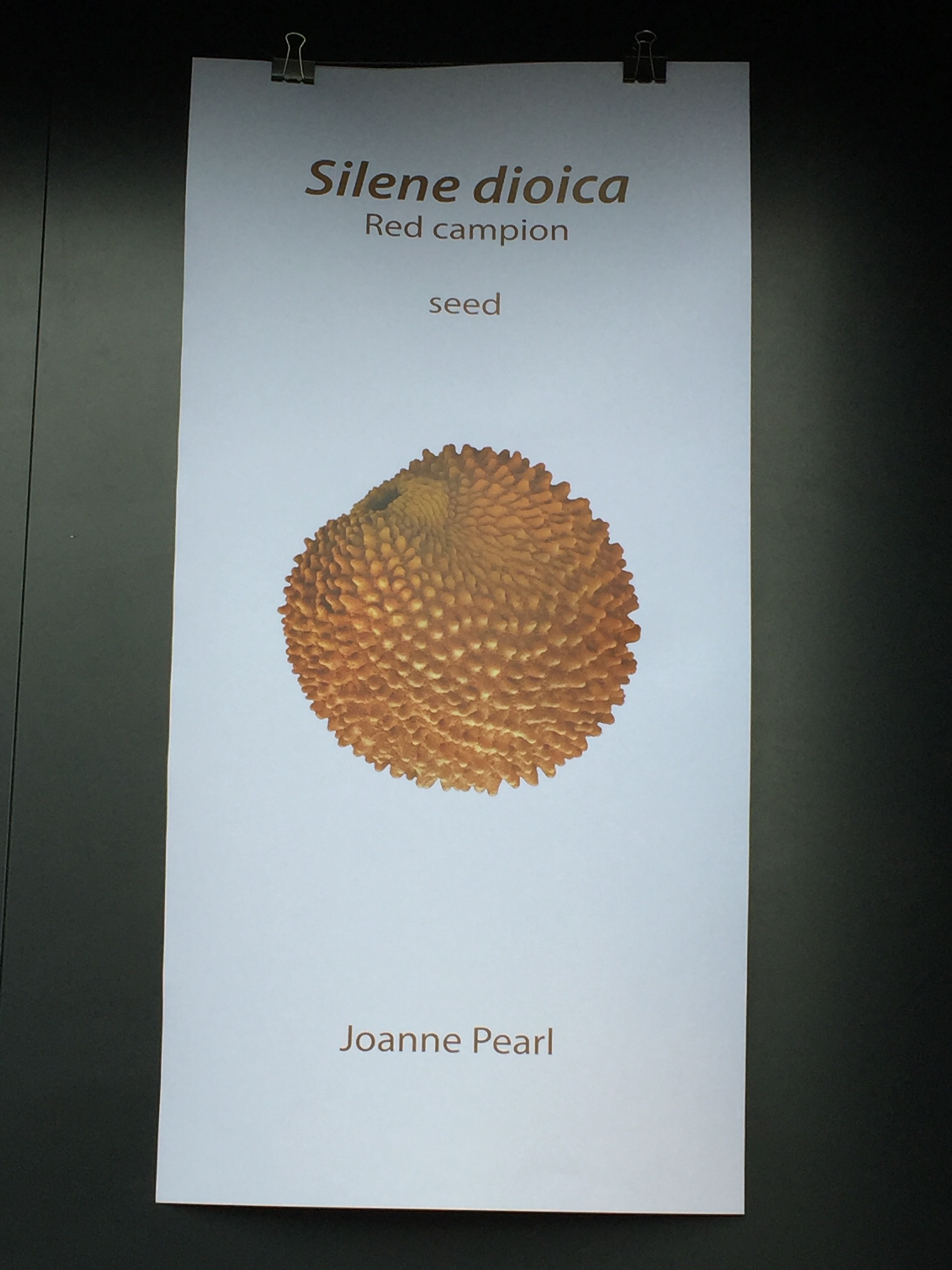
Well last Thursday was a Red Letter Day: the first time my ceramic work has been included in a public exhibition (not at college). The lovely folk at the Pangolin London Gallery on the ground floor of Kings Place included 10 pieces from the First Year BA Ceramic Design students in their Sculpture in the Garden Show, mine being one of them. The project on display are a series of huge ceramic seed pods hand coiled based on electron microscopic photos of various seeds taken by the wonderful CSM tutor Rob Kessler. Here is how my work looks in the Pangolin gallery windows.
Bisque fired clay rendition of Red Campion seed. It is about 50cm in diameter
I am particularly pleased that I managed to get the spikes on the underside of this piece. It’s all about the drying of the clay. Also many thanks to Campbell from the CSM jewellery dept who so kindly laser-soldered three special tools for me to make the zig-zag markings you can just about see in the image above.
Electron Microscopic image of a Red Campion seed taken by Rob Kessler, that was the starting point for my piece
So glad my first slip cast mugs have survived the first firing. The handle is supposed to suggest an ear shape. I’m thinking about doing some kind of eye or face screen-print decoration on one of them in the coming weeks.
Slip Cast Mug with Ear inspired handle
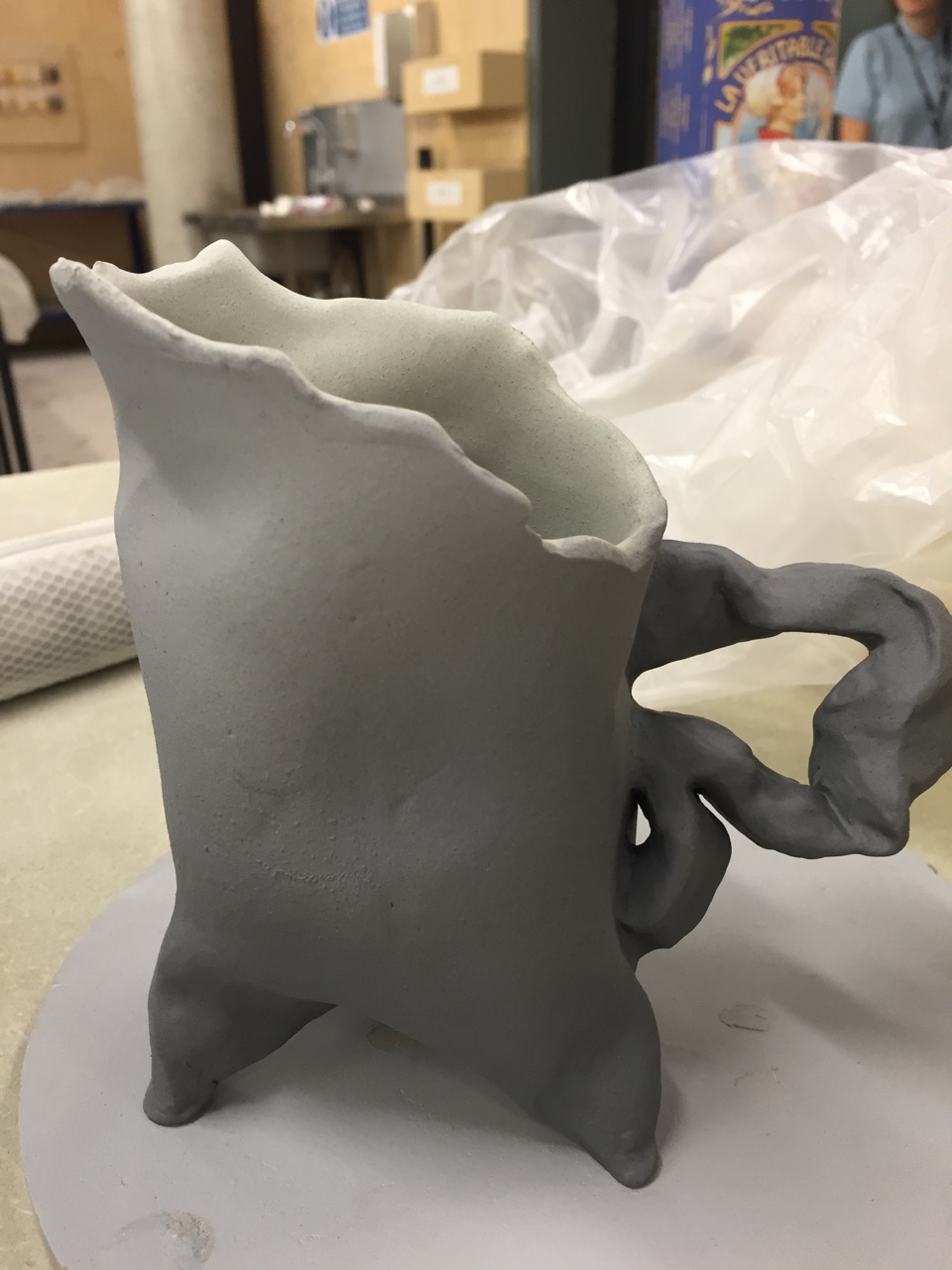
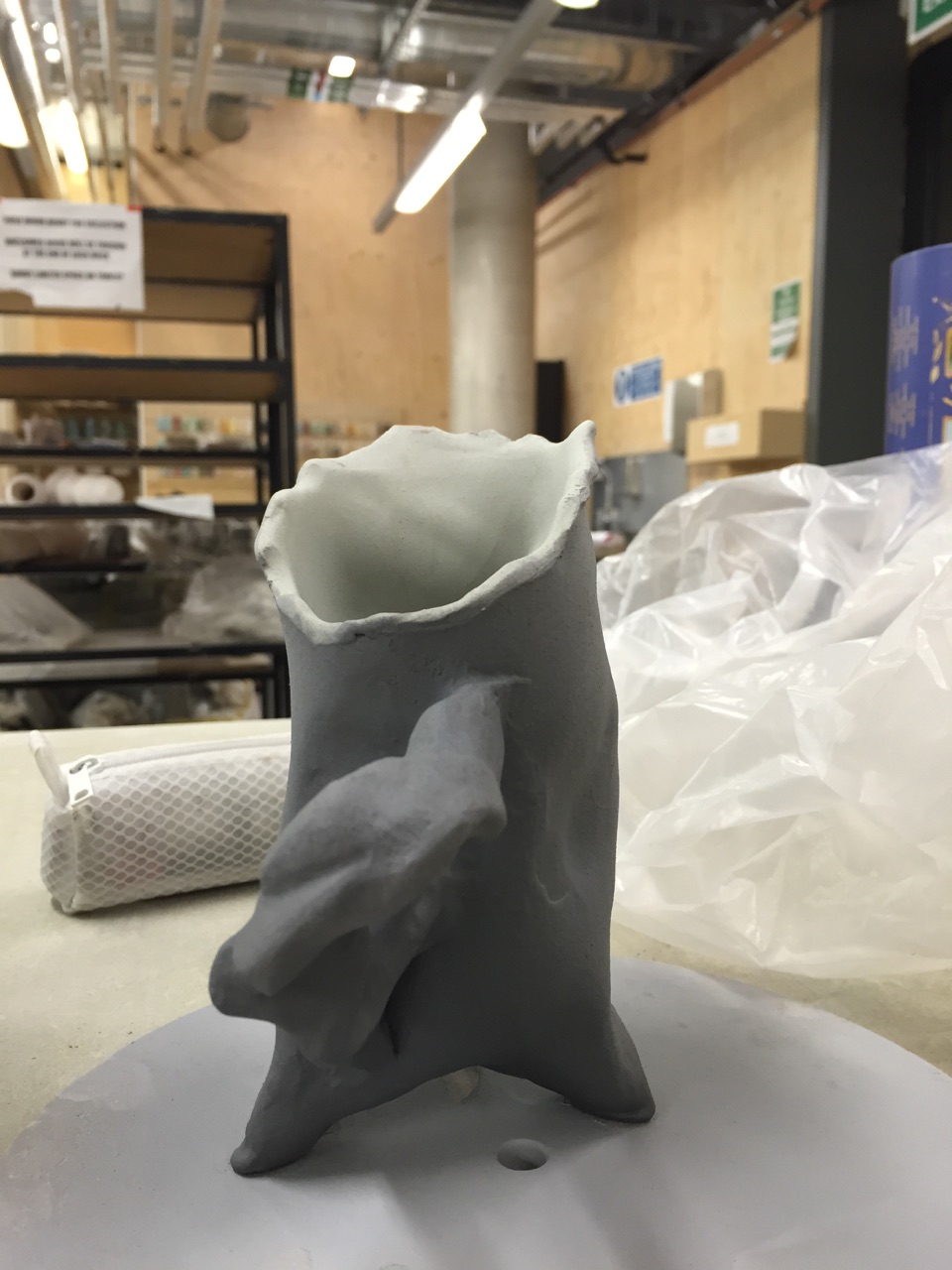
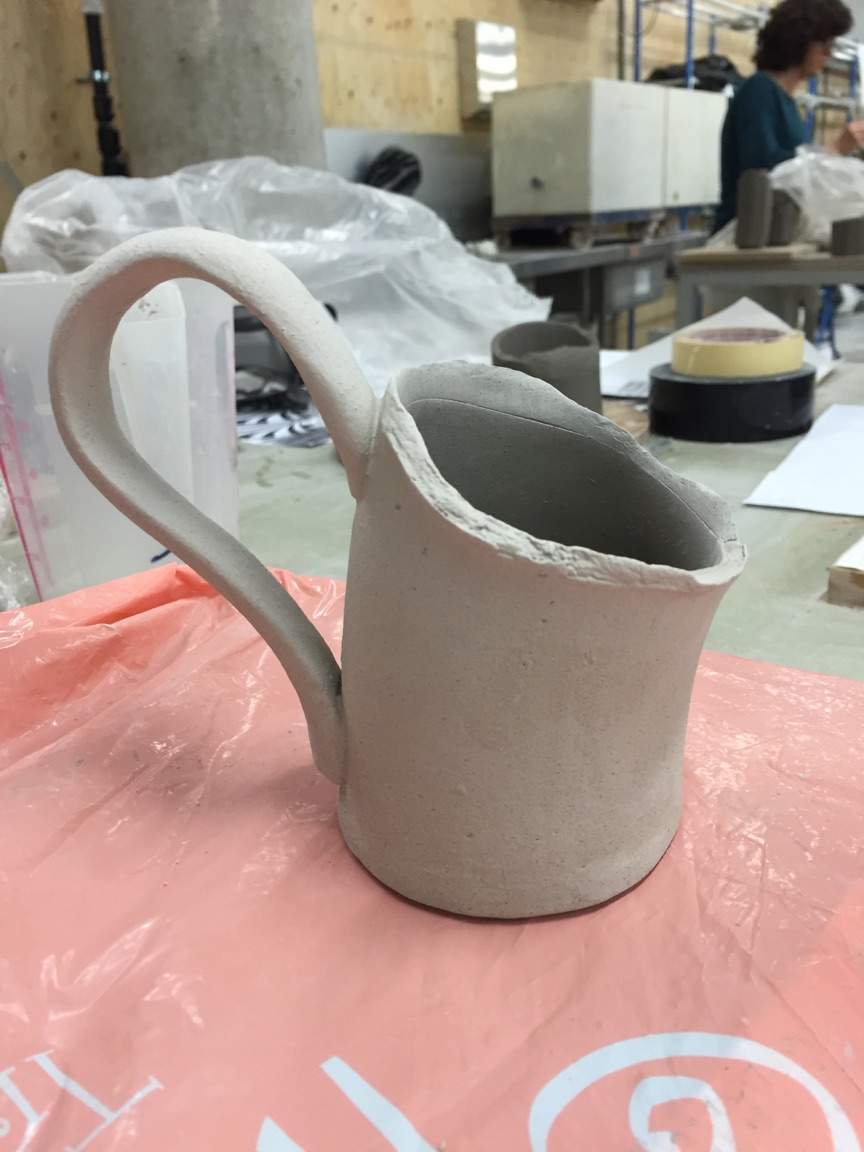
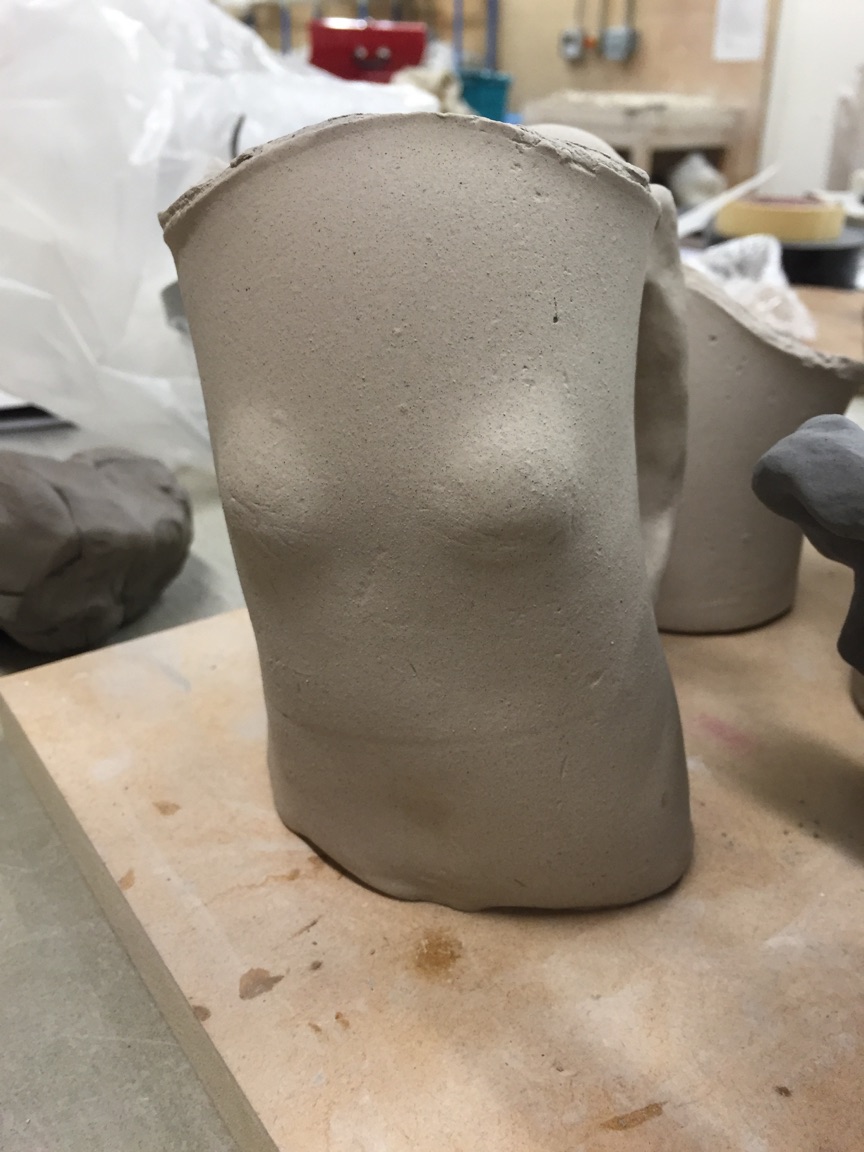
I have also been working on some hand-built mugs that started life as extruded tubes of clay. Most are non-functional, Having left the lip as torn clay as it came out of the extruder. I liked the effect that the torn clay makes.
Meanwhile we have also been discussing in class the fact that Ceramics is one of Man’s oldest known crafts and how our discipline can be used to chart the history of man-kind back to neolithic times. Some of these ideas have influenced the shapes I have gone for, and their decoration …
Mug as scooping cup, complete with torn clay lip
Inuit motif: Bushmen “Discussing the Hunt”
Nude Mug, sprayed with white slip, that is not visible at this stage
Mug as Nude Form with arm handle
Next up: glazing. We will be given an induction into glaze mixing and applying tomorrow. Can’t wait.
Well it has been a roaring 2 weeks since my first blog post.
Spode Chimney Kiln
I have been to the British Ceramics Biennial held in the disused Spode factory in Stoke on Trent, I have created plaster moulds for a mug and handle then slip caste them, six times. I have been to Expo in Milan for the day with the family, not to mention today’s blissful day experimenting in the studio extruding clay and playing with the results. Phew!
The visit to Stoke was inspiring and dispiriting by turns. Inside the exhibition were examples of the latest work by established artists and recent arts school graduates. Fingers crossed I will be exhibiting there in 3 years time! I was particularly impressed by the Clay Cargo exhibition put on by my CSM tutor, Duncan Hooson. The depth of the thinking and the amount of energy and commitment he and his co-conspirator Julia Rowntree of Claygound Collective bring to keep the making with clay alive by introducing it to new people was awe inspiring. A barge fitted out as a ceramic studio, navigating the canal waterways of Britain, (that were originally built by Josiah Wedgwood et al, as a means of connecting the potteries to the ports of Britain – who knew?). Then staging public events inviting the uninitiated to make a collective sculpture for the day. Rather like the one we students made on our first day of term.
James Duck
My favourite student work on show at the exhibition included James Duck’s vending machine with porcelain vessels in. For a mere £4 you could purchase an original celadon pot from the machine, have it roll forward and smash on a rock placed in the base of the vending machine. Ceramics are breakable, and on one level disposable after all! How long do we ever own them for? I bought a piece and it only chipped on the edge, and it now sits on my desk holding pens.
Hannah Tounsend’s thrown and caste pieces were beautiful too. And I was delighted to see Alex Simpson, my favorite from the RCA’s summer show.
Hannah Tounsend
But then wandering around this factory site, that has been derelict since 2008 when the loss adjusters came in, was depressing. Spode plate moulds were visible through cobweb windows.
Spode plate moulds, mouldering in a disused warehouse
Empty warehouses with up turned chairs. Luckily, we came across a maverick in a white jump suit, who was busy painting the walls of an empty unit near the edge of the site. He was setting up a new pottery studio, a professional ceramic painter, who had worked at Spode and currently at Emma Bridgewater, but who was going it alone. Then we discovered the Spode Visitor Centre and were heartened to meet former ceramic factory workers who were keeping the spirit alive, and who had good news about funds having been secured to save the massive Spode archive.
My family’s experience of seeing the city of Detroit hanging on by its finger nails over the last 20 years, and now getting on an even keel, with the threatened bankruptcy behind it and groovy arty types moving into the derelict warehouses downtown, makes me hope that Stoke on Trent and the heritage of Spode will secure a similar renaissance … Fingers Crossed that Stoke City’s victory over Chelsea FC last night is a good omen!
Go Stoke!!!
PS Here is what I have been up to in the studio today playing with extruded clay tubes to make drinking vessels. I couldn’t resist the pull of the human form!
So I have just finished my first week at CSM. Wow what a whirlwind!
Day One involved among other things creating a 21 person long clay sculpture, on the theme of “Where are you From?” I confess I got a bit sidetracked into “What is your background?” modeling Scandanavian jugs, my family and a human ear … but it was just fantastic to get my hands muddy again, and to learn a bit about the roots of my fellow students.
My contribution to the Great Wall of Ceramic Design Stage 1.
Mugged Up
Our first project is a 7 week investigation into Mugs. First up we learned how to use a lathe to sculpt a body of a mug out of plaster of Paris. Mine went slightly hors piste, in terms of the curves of the form, as I forgot to bring my spectacles into the studio, and got my measurements wrong. However, the final shape looks quite refined, and as one of my fellow students said “It is ladylike!”
We then made a plaster caste of that mug body, which will be used to slip cast our mugs in a few weeks time.
This weekend’s homework is to develop a design for a handle to go on the mug. I have decided that mine must be be able to accommodate 3 fingers, so be lovely and comfy, and suggest an ear shape. I am thinking that this will allow me to do some fun graphic interventions in the coming weeks to play with the face or mug of the mug.
What’s makes a good mug for you? Comments below please!































 Jo Pearl Sculpture