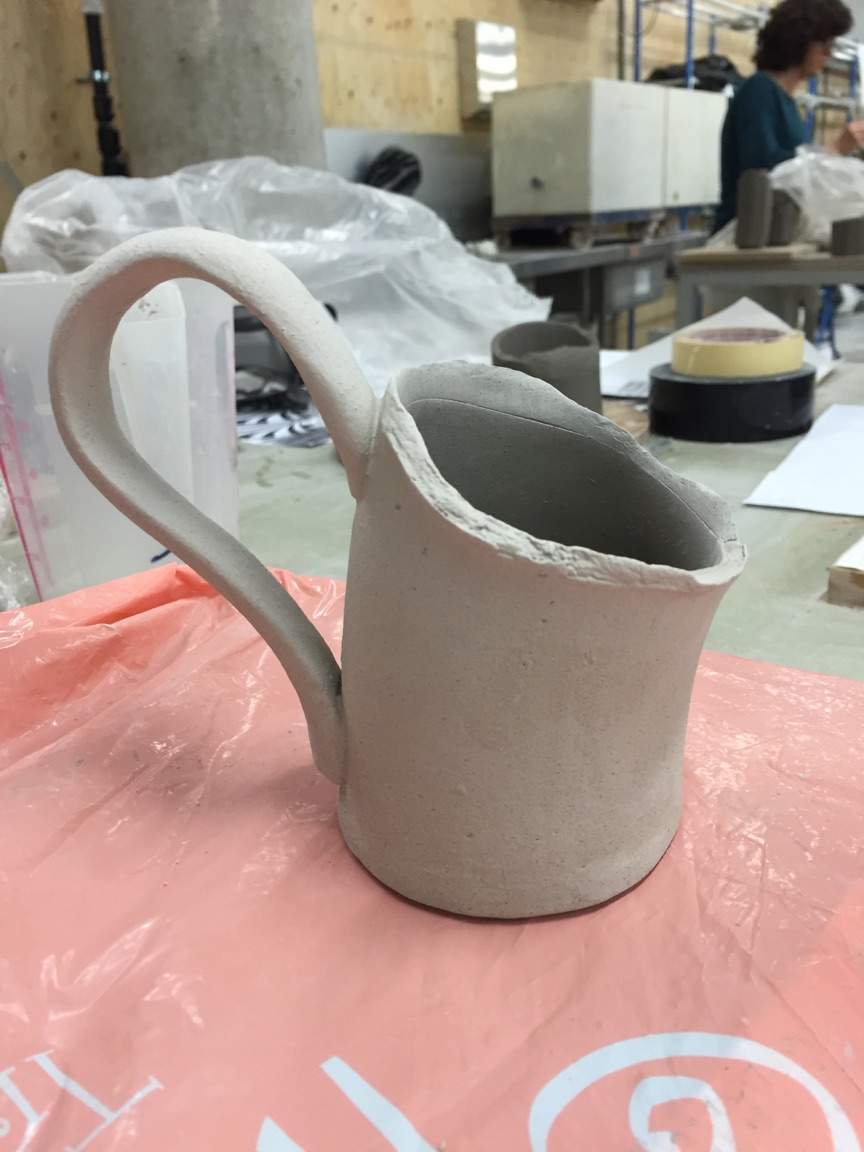
So glad my first slip cast mugs have survived the first firing. The handle is supposed to suggest an ear shape. I’m thinking about doing some kind of eye or face screen-print decoration on one of them in the coming weeks.
Slip Cast Mug with Ear inspired handle
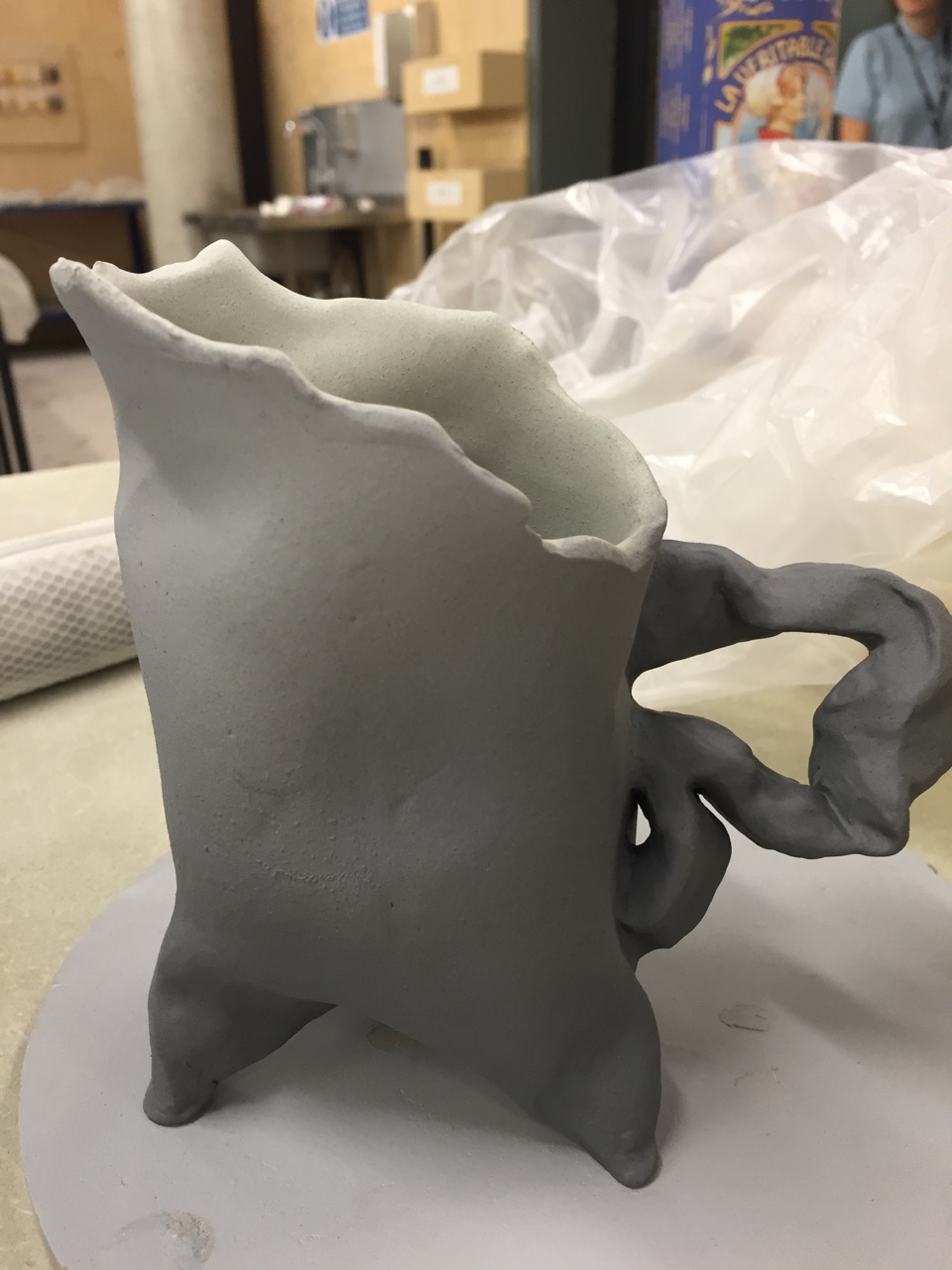
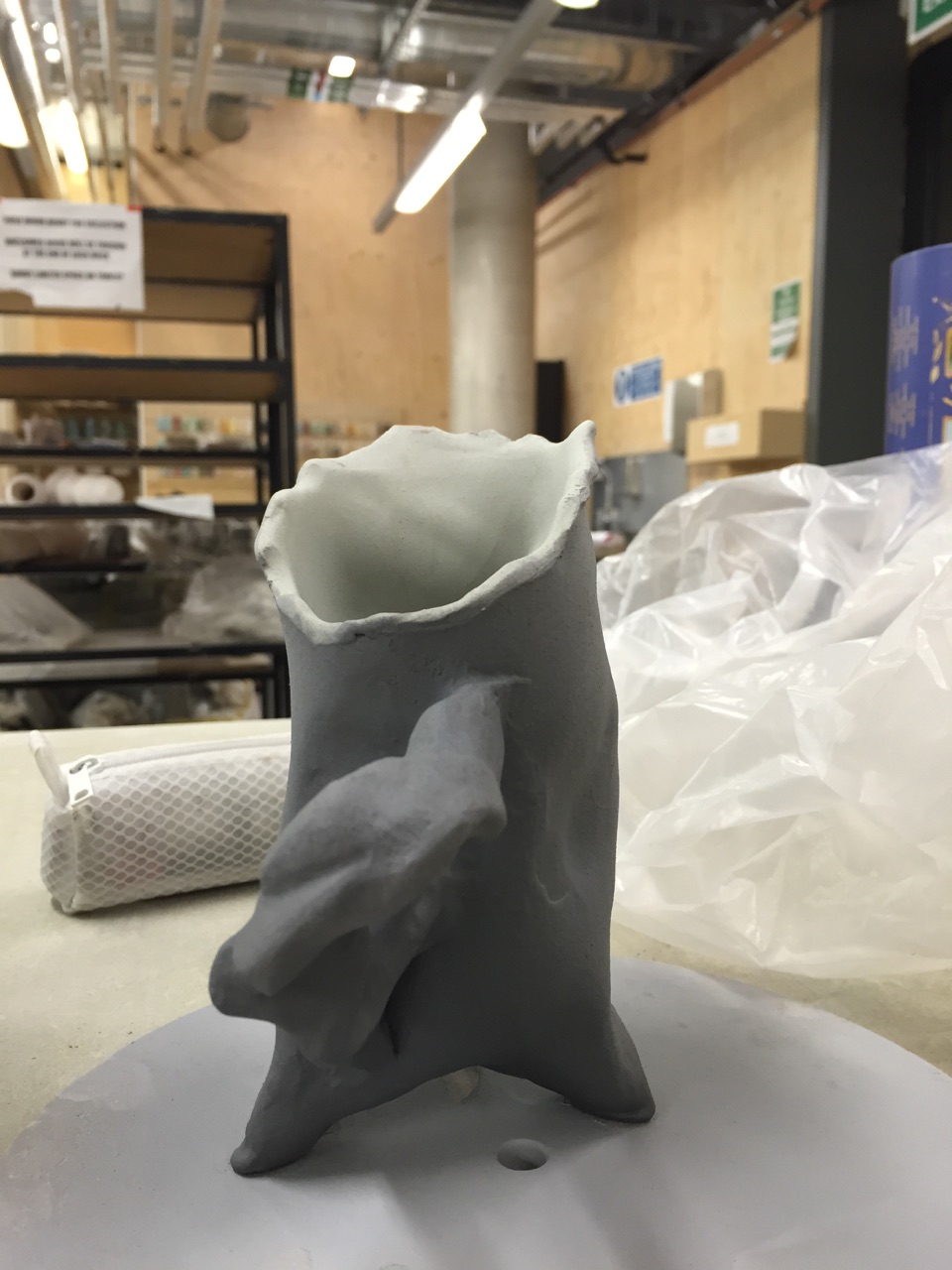
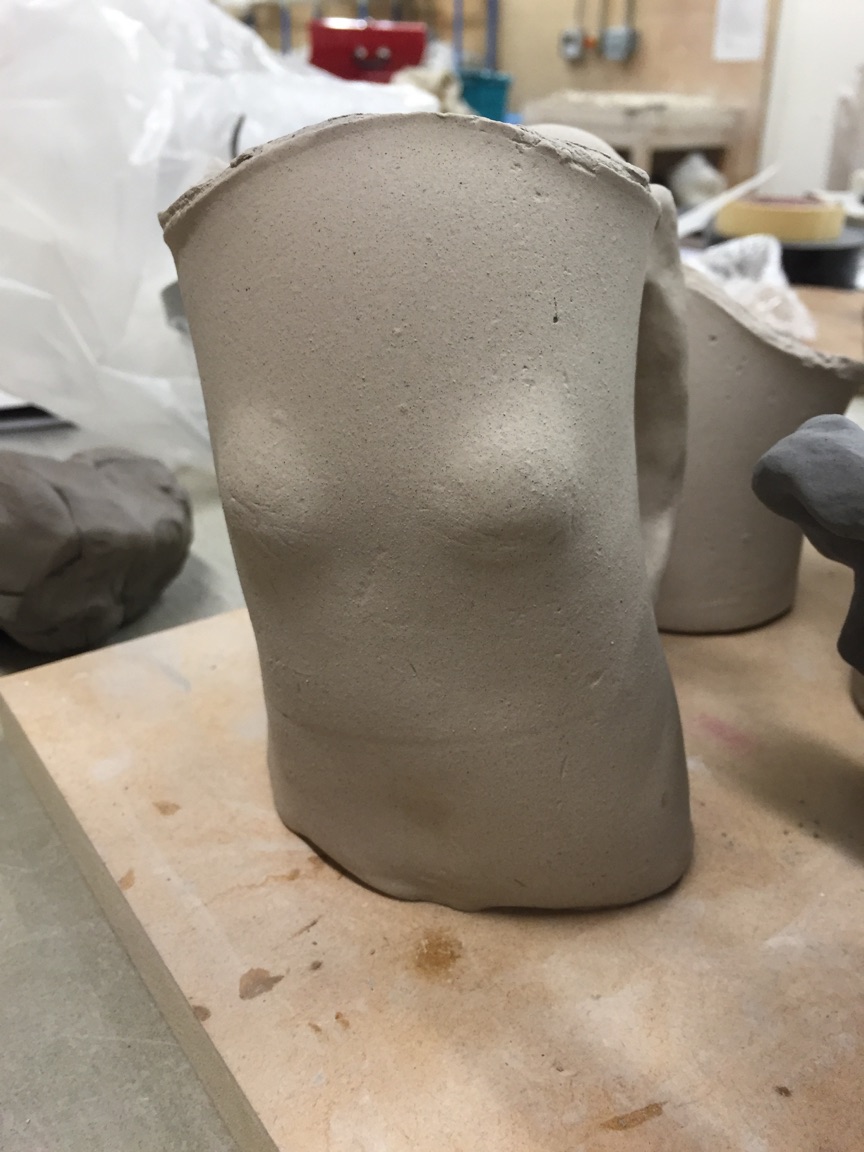
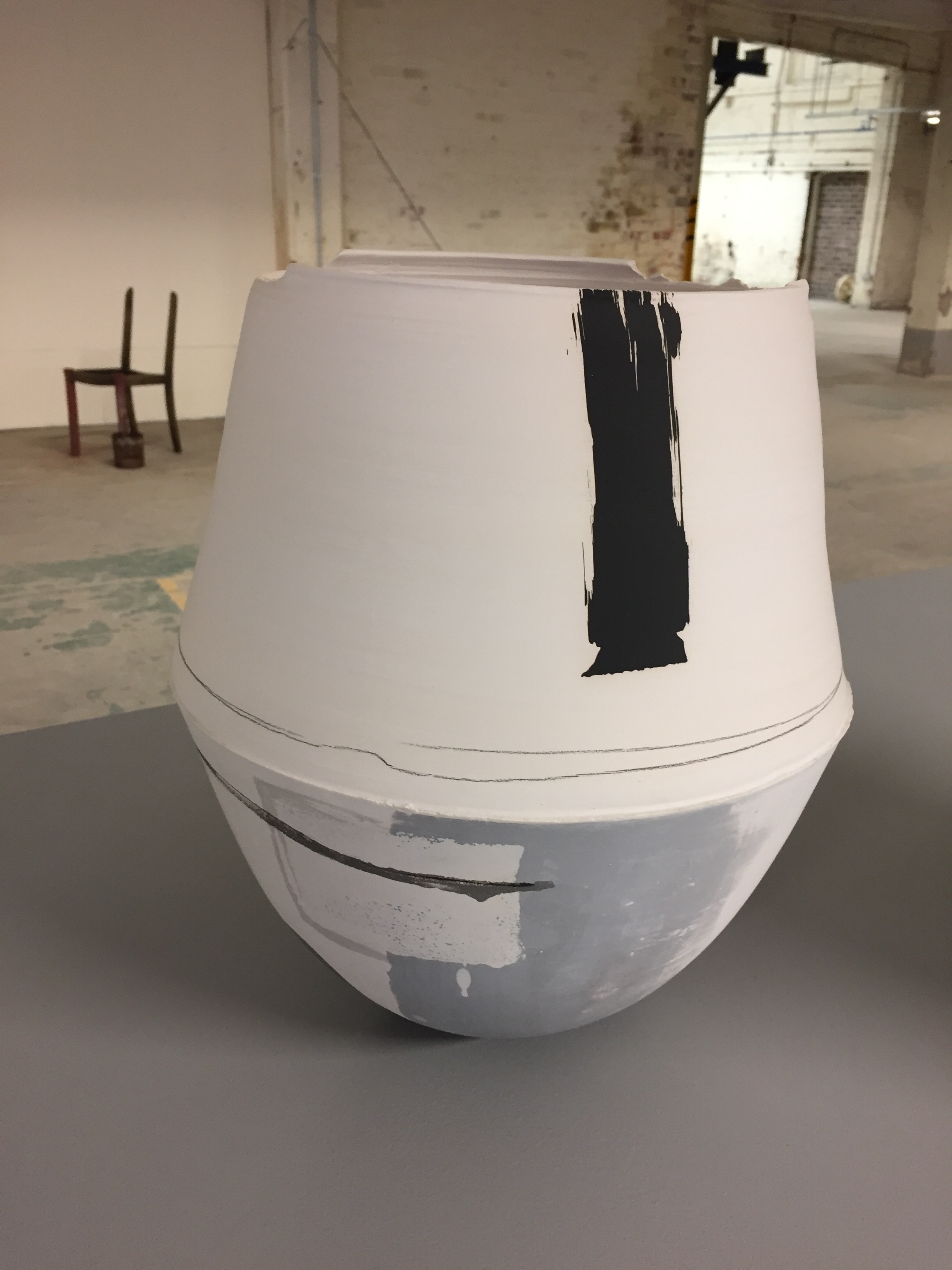
I have also been working on some hand-built mugs that started life as extruded tubes of clay. Most are non-functional, Having left the lip as torn clay as it came out of the extruder. I liked the effect that the torn clay makes.
Meanwhile we have also been discussing in class the fact that Ceramics is one of Man’s oldest known crafts and how our discipline can be used to chart the history of man-kind back to neolithic times. Some of these ideas have influenced the shapes I have gone for, and their decoration …
Mug as scooping cup, complete with torn clay lipInuit motif: Bushmen “Discussing the Hunt”Nude Mug, sprayed with white slip, that is not visible at this stageMug as Nude Form with arm handle
Next up: glazing. We will be given an induction into glaze mixing and applying tomorrow. Can’t wait.
Well it has been a roaring 2 weeks since my first blog post.
Spode Chimney Kiln
I have been to the British Ceramics Biennial held in the disused Spode factory in Stoke on Trent, I have created plaster moulds for a mug and handle then slip caste them, six times. I have been to Expo in Milan for the day with the family, not to mention today’s blissful day experimenting in the studio extruding clay and playing with the results. Phew!
The visit to Stoke was inspiring and dispiriting by turns. Inside the exhibition were examples of the latest work by established artists and recent arts school graduates. Fingers crossed I will be exhibiting there in 3 years time! I was particularly impressed by the Clay Cargo exhibition put on by my CSM tutor, Duncan Hooson. The depth of the thinking and the amount of energy and commitment he and his co-conspirator Julia Rowntree of Claygound Collective bring to keep the making with clay alive by introducing it to new people was awe inspiring. A barge fitted out as a ceramic studio, navigating the canal waterways of Britain, (that were originally built by Josiah Wedgwood et al, as a means of connecting the potteries to the ports of Britain – who knew?). Then staging public events inviting the uninitiated to make a collective sculpture for the day. Rather like the one we students made on our first day of term.
James Duck
My favourite student work on show at the exhibition included James Duck’s vending machine with porcelain vessels in. For a mere £4 you could purchase an original celadon pot from the machine, have it roll forward and smash on a rock placed in the base of the vending machine. Ceramics are breakable, and on one level disposable after all! How long do we ever own them for? I bought a piece and it only chipped on the edge, and it now sits on my desk holding pens.
Hannah Tounsend’s thrown and caste pieces were beautiful too. And I was delighted to see Alex Simpson, my favorite from the RCA’s summer show.
Hannah Tounsend
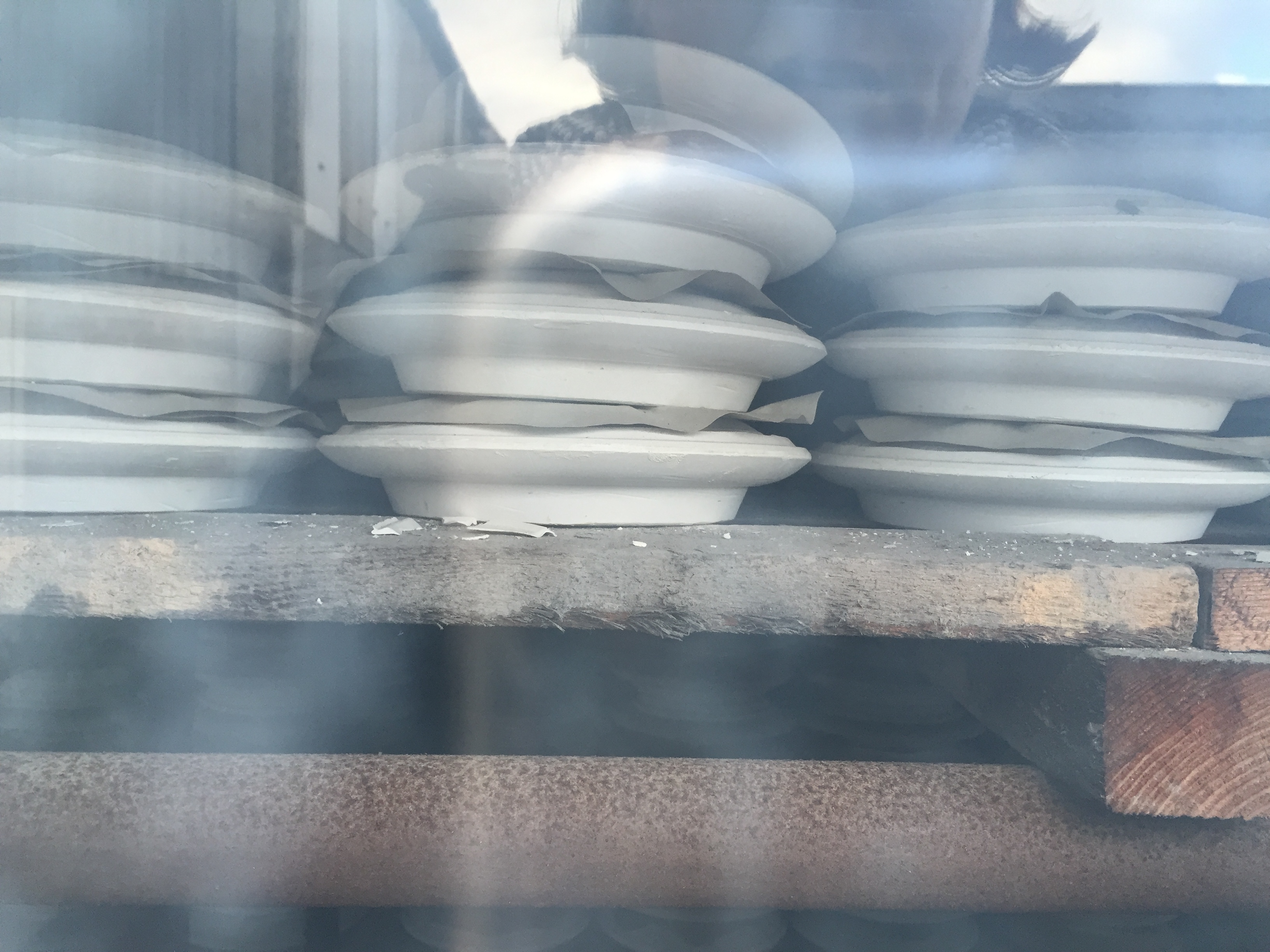
But then wandering around this factory site, that has been derelict since 2008 when the loss adjusters came in, was depressing. Spode plate moulds were visible through cobweb windows.
Spode plate moulds, mouldering in a disused warehouse
Empty warehouses with up turned chairs. Luckily, we came across a maverick in a white jump suit, who was busy painting the walls of an empty unit near the edge of the site. He was setting up a new pottery studio, a professional ceramic painter, who had worked at Spode and currently at Emma Bridgewater, but who was going it alone. Then we discovered the Spode Visitor Centre and were heartened to meet former ceramic factory workers who were keeping the spirit alive, and who had good news about funds having been secured to save the massive Spode archive.
My family’s experience of seeing the city of Detroit hanging on by its finger nails over the last 20 years, and now getting on an even keel, with the threatened bankruptcy behind it and groovy arty types moving into the derelict warehouses downtown, makes me hope that Stoke on Trent and the heritage of Spode will secure a similar renaissance … Fingers Crossed that Stoke City’s victory over Chelsea FC last night is a good omen!
Go Stoke!!!
PS Here is what I have been up to in the studio today playing with extruded clay tubes to make drinking vessels. I couldn’t resist the pull of the human form!
So I have just finished my first week at CSM. Wow what a whirlwind!
Day One involved among other things creating a 21 person long clay sculpture, on the theme of “Where are you From?” I confess I got a bit sidetracked into “What is your background?” modeling Scandanavian jugs, my family and a human ear … but it was just fantastic to get my hands muddy again, and to learn a bit about the roots of my fellow students.
My contribution to the Great Wall of Ceramic Design Stage 1.
Mugged Up
Our first project is a 7 week investigation into Mugs. First up we learned how to use a lathe to sculpt a body of a mug out of plaster of Paris. Mine went slightly hors piste, in terms of the curves of the form, as I forgot to bring my spectacles into the studio, and got my measurements wrong. However, the final shape looks quite refined, and as one of my fellow students said “It is ladylike!”
We then made a plaster caste of that mug body, which will be used to slip cast our mugs in a few weeks time.
This weekend’s homework is to develop a design for a handle to go on the mug. I have decided that mine must be be able to accommodate 3 fingers, so be lovely and comfy, and suggest an ear shape. I am thinking that this will allow me to do some fun graphic interventions in the coming weeks to play with the face or mug of the mug.
What’s makes a good mug for you? Comments below please!
So I realised that if you are not working from a live model, to sculpt a head you really need two views of the person in order to come up with a decent likeness. But where could I find the front and side views that I needed as visual reference? Then the idea of sculpting the portraits of convicts came to me, and I was amazed to find a treasure trove of black and white mug shots from the turn of the nineteenth century through the 1930’s that are available to download from the internet. I spent hours trawling through the websites of US museums of penatentury, and choosing the faces of some extraordinary people, some of whom were murderers, some of whom petty thieves.
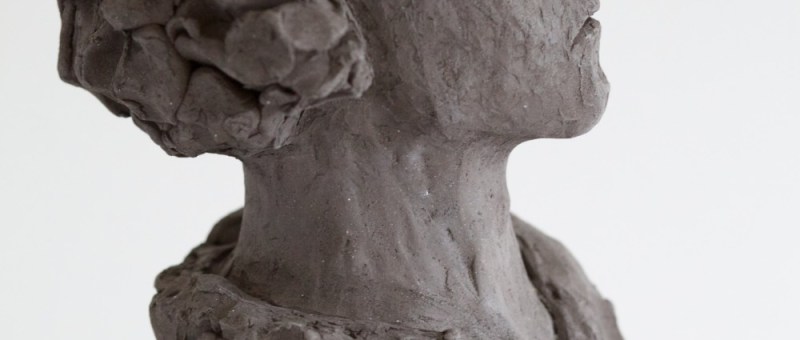
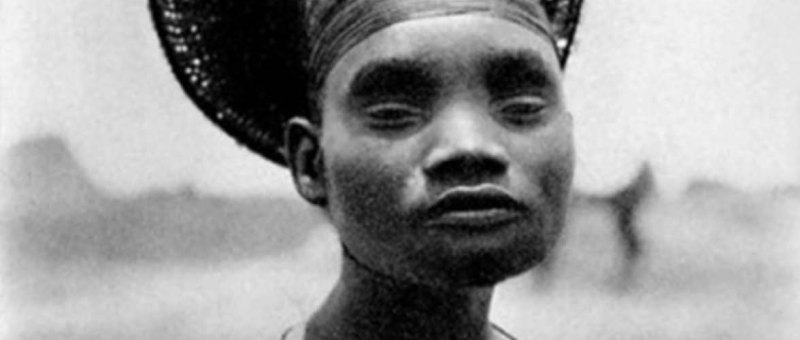
Below are the original mugshots and what I created as a result.
These photographs were taken around 1925 by a French anthropologist traveling in the Congo, formerly Zaire. With hindsight, the photos represent an objectification of this beautiful Mangbetu tribes woman, treating her like a convict by taking mugshots. It is shocking. I confess that I am torn. Showing the two views is extremely useful visual reference for me as a basis for a sculpture. But in so doing I am making use of this de-personalised view of the woman. There is an uncomfortable parallel between how Africa has been exploited by colonialism and post-imperialism and how I use the simple, dignified gaze of the woman as a starting point for my sculpture. I hope that my head does her justice to make my use worthwhile.
The Mangbetu tribes people had the practice of binding the skulls of babies from birth in order to elongate their shape to be able to accommodate the dramatic head-dresses that they traditionally wore. To a modern eye this practice would be deemed a form of torture. The practice has now largely died out. Probably due to Western influence and the migration of rural people to urban centres and the pressures of globalisation.
I recognise my British gaze is also influenced by a 21st Century perspective on this subjugation of women. Like FGM, and feet binding I do not condone the practice of the Mangbetu. It makes me feel queasy when I think what pain the women and children must have gone through to achieve this aesthetic. But neither is that to say that I don’t admire the graphic elegance of the effect that the headdress creates.











 Jo Pearl Sculpture